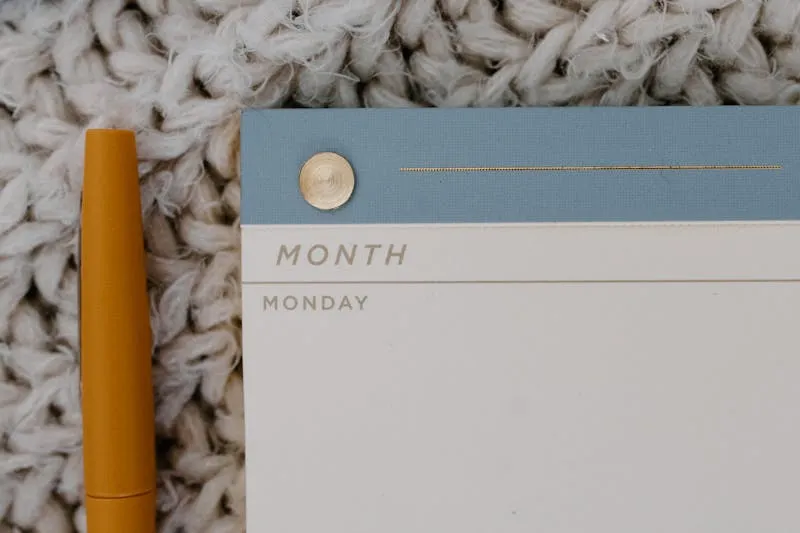
Hobonichi Cousin (A5)
HobonichiThe A5 version of the legendary Hobonichi planner. Same Tomoe River paper, same one-page-per-day format, but with nearly twice the page area and an exclusive weekly vertical section.
Best for: Journaling, detailed daily planning, sketch journaling, desk planner use
- Tomoe River paper (52gsm) in A5 format
- One-page-per-day with 544 pages
- Exclusive weekly vertical section for time-blocking
- Thread binding opens perfectly flat
- Monthly, weekly, and daily planning layers
The Hobonichi Techo Original is a legendary planner — we gave it a 4.8/5 in our review — but there’s always been one common complaint: the A6 pages are just too small. If you write large, sketch in your planner, or need room for detailed daily planning, the Original’s 3.7 x 5.2-inch pages fill up fast.
Enter the Hobonichi Cousin. Same Tomoe River paper. Same one-page-per-day format. Same meticulous Japanese craftsmanship. But in A5 — nearly twice the page area. The Cousin gives you the full Hobonichi experience with room to breathe.
We’ve used the Hobonichi Cousin as our primary daily planner for a full year, filling over 365 daily pages with schedules, notes, sketches, and the general detritus of daily life. Here’s our comprehensive review.
Quick Verdict: The Hobonichi Cousin is the best A5 daily planner available. The larger format solves the Original’s only real limitation — limited space — while preserving everything that makes the Hobonichi special. If you need more room than the A6 Original provides, the Cousin is worth every penny. Rating: 4.7 / 5.0
Product Overview
Approx. ~$45 (book only; covers sold separately) Brand: Hobonichi Origin: Japan Size: A5 (5.8 × 8.3 in / 148 × 210mm) Pages: 544 pages (daily, monthly, weekly vertical, reference) Paper: Tomoe River (52gsm) Weight: 21.2 oz (600g) Format: January–December daily pages, monthly calendars, weekly vertical (“Cousin-only” feature), reference pages Cover: Included basic cloth cover; decorative covers sold separately ($30–$100)
Hobonichi Cousin vs. Original: The Key Differences
Before diving into the review, let’s clarify what separates the Cousin from the Original:
| Feature | Cousin (A5) | Original (A6) |
|---|---|---|
| Page size | 5.8 × 8.3 in | 3.7 × 5.2 in |
| Page area | ~48 sq in | ~19 sq in |
| Pages | 544 | 448 |
| Weight | 21.2 oz | 7.1 oz |
| Weekly vertical | Yes | No |
| Portability | Desk/bag planner | Pocket-friendly |
| Price | ~$45 | ~$28 |
The critical difference beyond size: the Cousin includes a weekly vertical section (shuukan, 週間) that the Original lacks. This is a significant addition for people who plan their week by time blocks.
The Paper: Tomoe River at A5
The Cousin uses the same legendary Tomoe River paper (52gsm) as the Original. If you’ve read our Hobonichi Techo review, you know why this matters: the paper is impossibly thin yet handles ink beautifully. Colors pop, fountain pen inks sheen, and bleed-through is minimal despite the paper’s featherweight thinness.
At A5 size, the Tomoe River paper gains an additional advantage: larger writing areas mean more consistent ink behavior. On the A6 Original, you sometimes feel like you’re writing in a constrained space that limits natural pen movement. On the A5 Cousin, your hand has room to flow naturally, and the paper’s ink-handling qualities shine even more. Longer strokes show off the smoothness, and wider margins accommodate thicker pens without the page feeling cramped.
Pen Compatibility
We tested the Cousin with our standard pen battery:
- Pilot Juice Up 0.4mm: Excellent. Vivid lines, no bleed, minimal ghosting. Our recommended combination.
- Uni Jetstream 0.5mm: Excellent. Instant drying, minimal ghosting. The best option if ghosting bothers you. See our Uni Jetstream review.
- Pentel EnerGel 0.5mm: Very good. Slight ghosting but no bleed. Quick dry time.
- Pilot Metropolitan (F nib): Very good. Beautiful writing, slight ghosting, ink sheening visible.
- Tombow Dual Brush Pen: Good. Some bleed with heavy application, noticeable ghosting. Use light strokes.
- Zebra Mildliner: Good. Ghosting is visible but manageable. No bleed with single passes.
For detailed pen recommendations, see our guide to the best pens for Hobonichi.
Daily Pages: Room to Think
The Cousin’s daily pages are where the A5 format truly justifies its existence. Each daily page provides a generous 5.8 × 8.3-inch canvas divided by a subtle 3.7mm grid. That’s roughly 2.5 times the usable area of the Original’s daily pages.
What can you do with the extra space? Everything:
Layout Possibilities
Full-page scheduling: Divide the page into time blocks vertically, with a wide notes column on the right. The A5 page comfortably accommodates hourly blocks from 6 AM to midnight with room for notes beside each block.
Split layout: Use the top half for scheduling and the bottom half for journaling, to-do lists, or free writing. On the A6, this split feels cramped. On the A5, both halves have plenty of room.
Sketch + write: Many Cousin users dedicate a section of each daily page to small sketches, doodles, or illustrations. The A5 format gives you enough space to draw something meaningful while still having room for text.
Memory keeping: Tape in ticket stubs, sticky notes, receipts, or small photos. The A5 page provides enough area to include ephemera without covering your writing.
Habit tracking: Add a small habit tracker grid in the corner or margin. The extra space means you can track 5-10 habits daily without sacrificing your primary layout.
The Grid System
The 3.7mm grid is identical to the Original. Each daily page includes a time axis (hours from 0 to 24) along the left side, a subtle grid overlay, and the date and day of the week at the top. The grid is printed in a light gray that’s visible enough to guide your writing but subtle enough to disappear in photos and scans.
The Weekly Vertical: Cousin’s Secret Weapon
The feature that truly distinguishes the Cousin from the Original is the weekly vertical section — a Cousin-exclusive addition that many users consider the planner’s best feature.
Each weekly spread covers Monday through Sunday in vertical columns, with hourly time slots from 6 AM to midnight running down the left side. This creates a visual time-blocking layout that’s immediately intuitive: appointments are blocks of time, free periods are visible gaps, and your week’s structure is clear at a glance.
How We Use the Weekly Vertical
We use the weekly vertical as our primary scheduling tool and the daily pages as our detailed journal/notes tool. The weekly view shows the big picture — when meetings happen, when blocks of focused time are available, when deadlines fall. The daily pages capture the details — meeting notes, to-do lists, reflections, and ephemera.
This two-layer system is powerful. The weekly vertical answers “What’s happening this week?” at a glance. The daily page answers “What happened today?” in detail. Together, they provide comprehensive planning without redundancy.
Weekly Vertical vs. Digital Calendars
“Why not just use Google Calendar?” It’s a fair question. The weekly vertical is essentially a paper version of a digital calendar’s week view. The answer, for analog planning enthusiasts, is that writing appointments by hand creates stronger memory retention and a more tangible connection to your schedule. The Cousin’s weekly vertical doesn’t replace a digital calendar — it complements it.
Monthly Calendars
Each month opens with a two-page monthly calendar spread. The layout is a standard grid with generous box sizes for each date. There’s room for 3-4 entries per day — enough for key events, deadlines, and reminders without cluttering the view.
The monthly spreads serve as our high-level overview. Birthdays, travel dates, project deadlines, and recurring events go here. It’s the first thing we check each morning before diving into the weekly vertical and daily pages.
The Size and Weight Trade-Off
Let’s address the elephant in the room: the Hobonichi Cousin is a substantial book. At 21.2 oz (600g) and 544 pages, it’s nearly three times the weight of the A6 Original. This is not a pocket planner.
When the Size Works
- Desk planner: The Cousin lives beautifully on a desk, open to today’s page. The A5 size is the standard notebook format for a reason — it’s large enough to write comfortably and small enough to share desk space with a laptop.
- Bag carry: If you carry a bag or backpack daily, the Cousin fits comfortably alongside a laptop. Many commuters carry it in a tote bag without complaint.
- Home journal: If your planner lives on your nightstand, kitchen counter, or home office desk, the weight is irrelevant and the extra space is pure advantage.
When the Size Doesn’t Work
- Pocket carry: Not possible. The Cousin requires a bag.
- Minimalist EDC: If you’re optimizing for lightweight everyday carry, the Cousin is the wrong choice. Consider the A6 Original or the Hobonichi Weeks (wallet-sized).
- Travel: Packing the Cousin adds noticeable weight and bulk. Some travelers switch to the Weeks or a Traveler’s Notebook during trips.
Our Take on Size
For us, the extra space is worth the extra weight. We carry the Cousin in a shoulder bag daily, and the additional page area makes every planning session more productive and enjoyable. But we understand the trade-off, and we’d recommend the Original to anyone who prioritizes portability.
Build Quality and Covers
The Cousin comes with a basic cloth cover in a simple solid color. It’s functional but plain — the real cover game begins with Hobonichi’s annual lineup of designer covers, which range from $30 to $100+ and feature collaborations with artists, brands, and cultural icons.
The book binding is outstanding. The thread binding (糸綴じ, ito toji) allows the Cousin to open flat at any page without forcing or cracking the spine. After a full year of daily use, our Cousin’s binding remains tight and intact with no loose pages. The quality control is exceptional — we’ve never encountered a misprinted page, uneven trim, or binding defect in any Hobonichi product.
Pros & Cons
What We Love:
- Tomoe River paper in A5 format — the best planner paper at the best daily planner size
- Weekly vertical section is a game-changer for time-block planning
- One-page-per-day format provides generous space for journaling and scheduling
- Thread binding opens perfectly flat every time
- Extraordinary build quality and attention to detail
- The daily quotes at the bottom of each page add charm and personality
- Excellent pen compatibility across gel, ballpoint, and fine fountain pens
Room for Improvement:
- Heavy at 21.2 oz — not pocket-portable
- Expensive at $45 (plus $30-$100 for covers)
- Fixed January-December format — you can’t start mid-year
- One-page-per-day is too much space for some users, too little for others
- Limited cover options outside the annual release window
- Ghosting is visible with wet pens (inherent to Tomoe River paper)
- No lay-flat bookmark ribbon (only two thin ribbon markers)
Who Should Buy the Hobonichi Cousin?
- People who love the Original but need more space — This is the Cousin’s core audience, and it delivers perfectly
- Visual planners and sketch journalers — The A5 daily pages have enough room for illustration alongside text
- Time-block planners — The weekly vertical section is designed for you
- Desk planner users — The Cousin is ideal for a dedicated planning station at your desk
- Analog productivity enthusiasts — The three-layer system (monthly + weekly + daily) supports sophisticated planning methods
- Skip if: You need pocket portability, you prefer a blank/flexible planner system, or you don’t write enough to fill a daily page
Where to Buy
The Hobonichi Cousin is available from the official Hobonichi store (ships from Japan), Amazon, JetPens, and select stationery retailers. The annual lineup typically launches in September for the following year’s editions.
Check Hobonichi Covers on Amazon
Frequently Asked Questions
Is the Hobonichi Cousin too big for everyday carry?
It depends on your definition of “everyday carry.” If you carry a bag or backpack, the Cousin fits comfortably and the extra weight (21.2 oz) is manageable. If you want something that fits in a jacket pocket or goes out without a bag, the Cousin is too large — consider the A6 Original or the Hobonichi Weeks instead.
Hobonichi Cousin vs. Original — which should I buy?
Buy the Cousin if: you write large, you want the weekly vertical section, you plan at a desk, or you need room for sketches and ephemera. Buy the Original if: you need pocket portability, you write small, or you prefer a compact, carry-everywhere planner. The paper, print quality, and binding are identical in both — only the size, weight, and the weekly vertical section differ.
Does the Hobonichi Cousin work with fountain pens?
Yes, excellently. Tomoe River paper is beloved by fountain pen enthusiasts for its smoothness and ability to display ink properties like sheen and shimmer. Fine and medium nibs work best — broad nibs and very wet inks may cause ghosting or occasional bleed-through. We recommend extra-fine or fine nibs for daily planning use.
How do I use the weekly vertical section effectively?
Treat it as a visual overview of your week’s time commitments. Write appointments and events as blocks in the appropriate time slots and day columns. Use it alongside (not instead of) the daily pages — the weekly view shows your schedule structure, the daily pages capture details and notes. Color-coding with different pen colors makes the weekly vertical even more powerful.
Is $45 too expensive for a planner?
At $45, the Cousin is more expensive than most planners — but it’s also more planner than most planners. The Tomoe River paper alone justifies a premium, and the 544-page count, thread binding, and overall quality exceed what you’d get from competitors at any price. Think of it as less than $0.13 per daily page for an entire year of premium planning. We consider it excellent value.
Can I start using the Cousin mid-year?
The standard Cousin runs January through December, so starting mid-year means unused pages. Hobonichi does release a “Cousin Avec” edition that splits the year into two volumes (January-June and July-December), which allows for mid-year starts with the second volume. The Avec is also lighter since you’re only carrying half the year at a time.
Final Verdict
The Hobonichi Cousin is what happens when a company that already makes the best planner in the world decides to make a bigger version. The A5 format solves the Original’s only meaningful limitation — space — while the exclusive weekly vertical section adds genuine planning utility that justifies the upgrade.
The trade-off is portability. The Cousin is a desk planner or bag planner, not a pocket companion. If you accept that trade-off, you get the finest daily planning experience available: Tomoe River paper, meticulous build quality, and an intelligently designed three-layer planning system that adapts to virtually any planning style.
For those who need the space, nothing else comes close.
Rating: 4.7 / 5.0
For the complete Hobonichi lineup comparison, see our Hobonichi Techo review and Hobonichi vs. Traveler’s Notebook comparison.