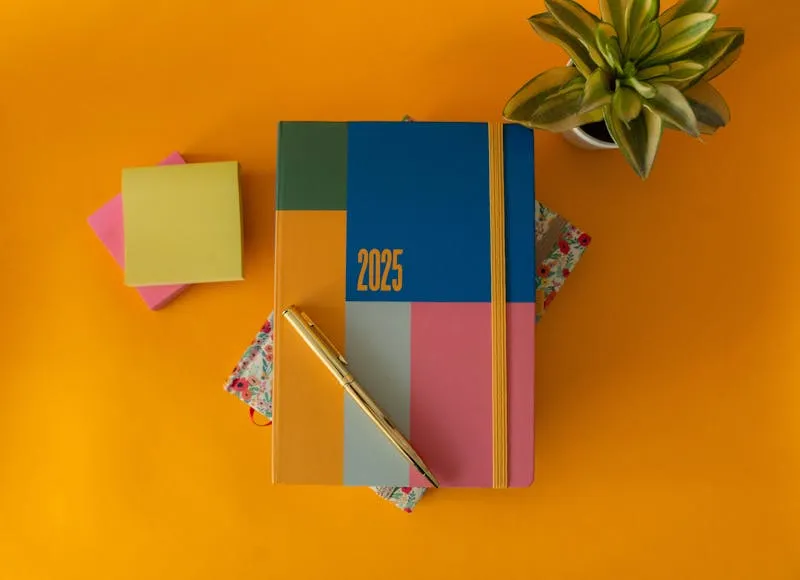
A decorated planner is more than pretty — it’s motivating. Research shows that visual appeal increases engagement with planning tools, which means a beautifully decorated planner gets used more consistently than a plain one. Japanese stationery provides the best tools for planner decoration: washi tape that repositions without damage, stickers that add functional beauty, highlighters that color-code without overwhelming, and stamps that add consistency.
Here are our favorite decoration techniques, organized from simple to elaborate. Start with the techniques that match your time and interest level.
Level 1: Simple Accents (2-3 minutes per spread)
Washi Tape Borders
The fastest way to add visual interest to any planner spread. Apply a strip of washi tape along the top or bottom of a page to create an instant border. This single strip transforms a blank page from clinical to inviting.
Technique: Tear (don’t cut) washi tape for a natural, handmade edge. Align with the page edge for a clean look or offset by 5mm for a layered effect.
Best tapes for borders: Narrow (7-8mm) patterns like polka dots, stripes, or subtle florals. See our washi tape collection guide for recommendations.
Color-Coded Headers
Write your headers (day names, section titles) with Zebra Mildliner highlighters. Use the broad chisel tip for background color behind the header text, or use the fine bullet tip to write the header directly in color.
Color scheme suggestion:
- Monday: Mild Blue
- Tuesday: Mild Green
- Wednesday: Mild Yellow
- Thursday: Mild Orange
- Friday: Mild Pink
- Saturday: Mild Purple
- Sunday: Mild Gray
This creates an instant rainbow effect across your weekly spread while serving the practical purpose of quick day identification.
Single Sticker Accent
Place one decorative sticker per page as a focal point. Choose a sticker that reflects the season (cherry blossoms in spring, maple leaves in autumn) or your current mood. One well-placed sticker adds personality without clutter.
Level 2: Moderate Decoration (5-10 minutes per spread)
Washi Tape Frames
Create a frame around your monthly or weekly spread using washi tape on all four edges. For a layered frame effect, use two different but complementary tapes — a wider tape on the outside and a narrow tape overlapping the inner edge.
Highlighter Background Boxes
Draw filled rectangles with Mildliner behind important sections. Use the broad tip to create a wash of color, then write over it with a fine black pen. This creates a section that stands out without using stickers or tape.
Best pen over highlighter: Sakura Pigma Micron — the archival ink writes cleanly over highlighter without smearing.
Stamped Headers
Use date stamps and decorative rubber stamps to create consistent headers. Stamp the date, then add a decorative stamp (weather icon, mood icon, theme icon) next to it. The stamped consistency across pages creates a cohesive journal aesthetic.
Tab Dividers
Use wide washi tape folded over page edges to create visible tab dividers. Label each tab with the month, week number, or section name. Tabs make navigation instant and add color to the page edges.
Level 3: Creative Decoration (15-20 minutes per spread)
Collage Pages
Combine stickers, washi tape, and ephemera (ticket stubs, receipts, postcards) into collage-style spreads. Layer elements to create depth — tape first, then stickers, then writing on top. This technique works best for memory-keeping pages, trip journals, and monthly cover pages.
Tip: Use a glue pen or Japanese glue for adhering non-sticky ephemera. The Tombow Mono Adhesive is popular for clean, precise adhesion.
Themed Monthly Covers
Dedicate the first page of each month to a themed cover page. Choose a visual theme (nature, food, travel, seasons) and decorate using stickers, washi tape, and illustrations that match. These cover pages make flipping through your planner a visual delight.
Monthly theme ideas:
- January: New Year / snow / minimalist white
- February: Hearts / pastels / warmth
- March: Cherry blossoms / spring awakening
- April: Sakura / fresh green
- May: Flowers / gardens / growth
- June: Rain / hydrangea / blue tones
- July: Ocean / summer festival / fireworks
- August: Sunflowers / tropical / bright colors
- September: Autumn leaves / harvest / warm tones
- October: Halloween / cozy / orange
- November: Gratitude / warm neutrals
- December: Winter / holiday / gold and green
Brush Lettering Headers
Use a Pentel Fude Touch Sign Pen or Tombow Dual Brush Pen to create calligraphic month and week headers. Brush lettering adds a handmade, artistic quality that printed text and standard pens can’t replicate.
Practice on scratch paper before committing to your planner. The Kokuyo Campus paper handles brush pen ink well without bleeding.
Level 4: Advanced Techniques (20+ minutes per spread)
Watercolor Accents
Add light watercolor washes to planner pages using Tombow Dual Brush Pens on a palette (or directly blended with a water brush). Apply a light wash, let it dry completely, then write over it.
Important: This technique requires paper that handles water. Kokuyo Campus handles light washes. Tomoe River paper (in Hobonichi) handles water poorly — stick to dry media in Hobonichi planners.
Mixed Media Layouts
Combine multiple techniques in a single spread: washi tape border, stamped header, sticker accents, color-coded text, and a small illustration. The key to avoiding chaos is maintaining a consistent color palette — choose 3-4 colors that work together and use them across all elements.
Custom Stencil Layouts
Use templates and stencils to create consistent recurring layouts — habit trackers with perfect circles, calendar grids with aligned boxes, weekly layouts with proportional day sections. Pencil the template first, then ink over it for a professional, consistent result.
Decoration by Planner Type
Hobonichi Techo
- Best media: Fine-tip pens (0.3-0.5mm), small stickers, narrow washi tape
- Avoid: Heavy wet media (watercolor, thick markers) — Tomoe River paper is thin
- Key tip: The daily page grid serves as a guide for aligned decoration
- See also: Best pens for Hobonichi
Bullet Journal
- Best media: Any pen, highlighters, washi tape, stickers, stamps, light watercolor
- Key tip: Design your layout in pencil first, then decorate after inking
- See also: Bullet journal supplies
Traveler’s Notebook
- Best media: Stamps, kraft-friendly stickers, washi tape, collage elements
- Key tip: The kraft paper refills accept stamps beautifully and complement vintage aesthetics
- See also: Traveler’s Notebook customization
Softcover Planner (MD Notebook, Stalogy, Rollbahn)
- Best media: Fine-tip pens, Mildliners, washi tape, stickers — these papers handle a wide range
- Key tip: The unstructured pages give you maximum layout freedom; grid or dot versions let you create custom weekly formats from scratch
- Avoid: Heavy embossing or adhesive that might warp the softcover binding
- Supply to try: A Pentel Energel 0.5mm for precise line work on any uncoated paper stock — the fast-drying gel ink prevents smearing when you lay tape or stickers immediately after writing
Essential Tools for Planner Decoration
| Tool | Purpose | Our Pick |
|---|---|---|
| Washi tape | Borders, frames, accents | mt tape |
| Stickers | Decoration, icons | Mind Wave flakes |
| Highlighters | Color-coding, backgrounds | Zebra Mildliner |
| Fine pen | Writing over decoration | Sakura Pigma Micron |
| Brush pen | Headers, lettering | Pentel Fude Touch |
| Stamps | Dates, icons | Midori date stamp |
| Ruler | Straight lines, layouts | Midori Aluminum |
Frequently Asked Questions
How do I keep decoration from becoming overwhelming?
Limit your color palette to 3-4 colors per spread. Choose one focal element (a large sticker, a brush-lettered header, a washi tape frame) and keep everything else simple. Negative space (blank areas) is part of the design — don’t fill every inch.
How much time should I spend decorating vs. planning?
This is personal. Some people find decoration therapeutic and spend equal time decorating and planning. Others prefer minimal decoration that takes 2-3 minutes. If decoration is preventing you from actually using your planner, simplify. The planner’s primary job is organization, not beauty.
Do I need artistic talent to decorate a planner?
No. Washi tape, stickers, and stamps require zero artistic ability. Color-coding with highlighters is straightforward. The only technique that benefits from practice is brush lettering, and even that is optional. Start with simple techniques and add complexity only as you develop confidence and interest.
How do I develop my own decoration style?
Browse planner communities on Instagram and Pinterest for inspiration, then experiment. Over 2-3 months, you’ll naturally gravitate toward certain colors, techniques, and levels of decoration. Your style emerges from what you enjoy doing, not from what looks good in photos.
Where do I buy Japanese planner decoration supplies?
Amazon for basics, JetPens for the widest selection, Kinokuniya for in-person browsing. For our complete sourcing guide, see where to buy Japanese stationery.
How do I protect finished planner spreads from smearing or fading?
For spreads you want to preserve long-term — travel journals, monthly covers, milestone pages — a light coat of a matte fixative spray over dry media (pencil, pen, stamps) locks everything in place and prevents smudging. Test on a scrap page first, as some fixatives subtly alter paper texture. Washi tape and stickers don’t require fixative. For everyday weekly spreads, the main protection is letting all inks dry fully before closing the planner — pigment inks like Sakura Pigma Micron are archival and stable without any extra treatment. Dye-based markers (including some Mildliner shades) may fade in direct sunlight over months; keeping your planner out of prolonged sun exposure preserves color vibrancy.
Can I decorate a planner that’s already half-used?
Absolutely. Starting mid-year is one of the best ways to try decoration without committing to a full year’s aesthetic. Treat the remaining pages as a fresh start — pick a new color palette, try a technique you’ve been hesitant about, or simplify your previous approach if it felt time-consuming. Your decoration style will naturally evolve, and a planner that shows that progression is more interesting than one with forced consistency.