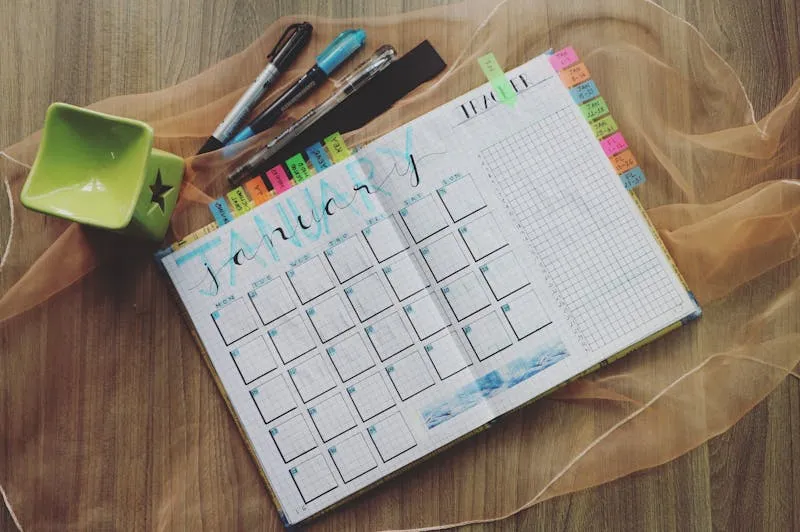
Learning Japanese is a multi-year project. Without a system to track your progress, plan your study sessions, and maintain accountability, it’s easy to lose momentum. A dedicated language learning planner turns the overwhelming goal of “learn Japanese” into manageable daily tasks, trackable milestones, and visible progress.
We’ve used various planner systems throughout our Japanese learning journey — from the Hobonichi Techo to custom bullet journal layouts to simple binder systems. Here’s how to set up a language learning planner that keeps your Japanese study on track.
Choosing Your Planner Format
Option 1: Hobonichi Techo (Daily Pages)
Best for: Detailed daily tracking, journaling your study experience Price: ~$30-50
The Hobonichi Techo provides one page per day on ultra-thin Tomoe River paper. Each page includes a time axis (hourly blocks) that’s perfect for scheduling study sessions and a generous writing area for notes, vocabulary, and reflections.
Use the daily page to:
- Schedule specific study tasks (30 min grammar, 20 min Anki, 15 min reading)
- Record new vocabulary encountered during the day
- Write a brief reflection on what you learned (in Japanese, once you’re able)
- Track which textbook lessons you completed
The Hobonichi’s monthly calendar pages work well for long-term goal tracking — mark JLPT exam dates, milestone goals, and review periods.
Option 2: Bullet Journal (Custom Layouts)
Best for: Flexible tracking, visual learners, creative planners Price: ~$5-15 (notebook) + pens
A bullet journal in a dotted Kokuyo Campus or Midori MD notebook gives you complete control over your planner layout. You can design exactly the tracking spreads you need and modify them as your study evolves.
This is our recommended approach for most learners because language study needs change over time. A beginner’s planner looks very different from an intermediate learner’s planner. The bullet journal format lets you adapt without switching systems.
Option 3: Binder System (Modular)
Best for: Organized study with multiple subjects, JLPT preparation Price: ~$10-20 (binder + paper)
A slim binder with loose-leaf paper lets you create modular study sections that you can reorganize, expand, and archive as needed. This is especially useful for JLPT preparation, where you need separate sections for grammar, vocabulary, reading, and listening practice across multiple levels.
Essential Planner Spreads
1. Long-Term Goals Page
At the front of your planner, create a goals page that outlines:
Your overall objective: (e.g., “Pass JLPT N3 by December 2025”)
Milestone breakdown:
- Month 1-2: Complete Genki I Chapters 1-12
- Month 3-4: Complete Genki I Chapters 13-23 + begin Genki II
- Month 5-6: Complete Genki II Chapters 1-12
- Month 7-8: Begin JLPT N3 preparation materials
- Month 9-10: Practice tests and review
- Month 11-12: Final review and exam
Measurable targets:
- Learn 1,500 vocabulary words
- Learn 600 kanji
- Complete 100 hours of listening practice
- Read 20 graded readers
This page is your North Star. Review it monthly and adjust as needed.
2. Monthly Overview Spread
At the start of each month, create a two-page spread:
Left page — Calendar view:
- Mark study days vs. rest days
- Note key deadlines (textbook chapter completion, practice tests)
- Track consecutive study days (streaks are motivating)
Right page — Monthly goals:
- 3-5 specific, measurable goals for the month
- Textbook progress targets
- Vocabulary/kanji count targets
- Skills to focus on (reading, listening, speaking, writing)
3. Weekly Study Plan
Each week, create a detailed plan:
| Day | Morning | Afternoon | Evening |
|---|---|---|---|
| Mon | Anki review (20 min) | Textbook Ch. 5 (45 min) | Podcast listening (20 min) |
| Tue | Anki review (20 min) | Kanji practice (30 min) | Reading practice (20 min) |
| Wed | Anki review (20 min) | Textbook Ch. 5 cont. (45 min) | Conversation practice (30 min) |
| Thu | Anki review (20 min) | Grammar review (30 min) | Podcast listening (20 min) |
| Fri | Anki review (20 min) | Textbook Ch. 6 (45 min) | Free reading (20 min) |
| Sat | Extended review (45 min) | Textbook Ch. 6 cont. (45 min) | Watch Japanese media (40 min) |
| Sun | Light review (15 min) | Rest | Weekly reflection (15 min) |
4. Vocabulary Tracker
Create a running vocabulary log organized by date or theme:
| Date | Word | Reading | Meaning | Example Sentence | Source |
|---|---|---|---|---|---|
| 5/10 | 図書館 | としょかん | Library | 図書館で勉強します | Genki Ch. 3 |
| 5/10 | 借りる | かりる | To borrow | 本を借りました | Genki Ch. 3 |
Color-code entries by word type using Zebra Mildliner highlighters: verbs in blue, nouns in yellow, adjectives in pink.
5. Kanji Progress Tracker
Track kanji learning with a grid-based system:
Create a grid with boxes for each kanji you need to learn (e.g., 200 boxes for JLPT N5 kanji). Color each box as you learn the character:
- Pencil outline — Introduced but not memorized
- Half-filled — Can recognize but not write from memory
- Fully filled — Can read, write, and use in context
This visual tracker shows your progress at a glance and is deeply satisfying to fill in.
6. Habit Tracker
Track daily study habits with a simple grid:
| Habit | 1 | 2 | 3 | 4 | 5 | 6 | 7 | … | 30 |
|---|---|---|---|---|---|---|---|---|---|
| Anki review | X | X | X | X | X | X | … | ||
| Textbook study | X | X | X | X | X | … | |||
| Kanji practice | X | X | X | X | X | … | |||
| Listening | X | X | X | X | … | ||||
| Reading | X | X | X | … |
Aim for consistency rather than perfection. A 20-minute daily session beats a 3-hour weekend marathon.
7. JLPT Countdown Tracker
If you’re targeting a specific JLPT exam date, create a countdown page:
- Days remaining until exam
- Grammar points covered vs. remaining
- Vocabulary learned vs. target
- Practice test scores over time
- Weak areas to focus on
For JLPT-specific stationery recommendations, see our JLPT study stationery guide.
Stationery for Your Planner
The right tools make planner creation and maintenance enjoyable:
- Notebook: Kokuyo Campus dotted B5 for bullet journal or Hobonichi Techo for daily planner
- Primary pen: Uni Jetstream 0.5mm for neat, quick-drying writing
- Highlighters: Zebra Mildliner set for color-coding
- Ruler: For drawing clean tables and section dividers
- Stickers/tabs: For marking important pages and sections
For a complete list of recommended study stationery, see our Japanese stationery for studying guide. And if you need a reliable reference companion for your study sessions, our best Japanese dictionaries guide covers the top options for every level.
Tips for Maintaining Your Planner
Review Weekly
Every Sunday, spend 15 minutes reviewing the past week. What did you accomplish? What did you skip? What needs more attention? Use this reflection to plan the following week more realistically.
Be Honest About Time
It’s better to plan 20 minutes of daily study and actually do it than to plan 2 hours and repeatedly fail. Start with an amount you can sustain and increase gradually. Consistency is everything in language learning.
Track Time, Not Just Tasks
Record how many minutes you actually studied each day. Over weeks and months, this data reveals patterns — you might discover you study best in the morning, or that you consistently skip Thursday sessions. Use these insights to optimize your schedule.
Celebrate Milestones
When you complete a textbook chapter, learn 100 new kanji, or pass a practice test, mark it in your planner with a special notation. Looking back at accumulated milestones during motivation slumps is powerful encouragement.
Write in Japanese
As your ability improves, start writing planner entries in Japanese. Even simple things — dates, day-of-week labels, basic notes — reinforce daily use. By intermediate level, try writing your weekly reflections entirely in Japanese.
Frequently Asked Questions
Do I need a separate planner for language study?
It depends on how much you study. If Japanese is a casual hobby (30 minutes a few times per week), integrate it into your regular planner. If you’re studying seriously (1+ hours daily), a dedicated planner keeps language study organized without cluttering your daily schedule.
Digital planner vs. paper planner for language study?
Paper, strongly. The act of handwriting your plans, goals, and reflections reinforces the study material and builds the habit of Japanese handwriting. Digital planners are convenient but lack the memory benefits of physical writing. Use paper and quality pens for your planner.
How detailed should my study plan be?
Start detailed and simplify over time. Beginners benefit from specific plans (“Study Genki Chapter 3 grammar points for 30 minutes”). As you develop study habits, you can become more flexible (“Grammar study 30 min” without specifying the exact content).
What if I fall behind my plan?
Falling behind is normal and expected. Don’t try to “catch up” by cramming — this undermines spaced repetition. Instead, adjust your plan forward. If you planned to finish Genki I by month 4 but you’re only on Chapter 15, extend the timeline. Progress at a sustainable pace always beats abandoned ambitious plans.
Should I track vocabulary in my planner or a separate notebook?
We recommend a separate vocabulary notebook for detailed word entries and a simple count tracker in your planner. The planner tracks “how many words this week” for motivation and goal tracking. The vocabulary notebook stores the actual words with definitions, readings, and example sentences for review.