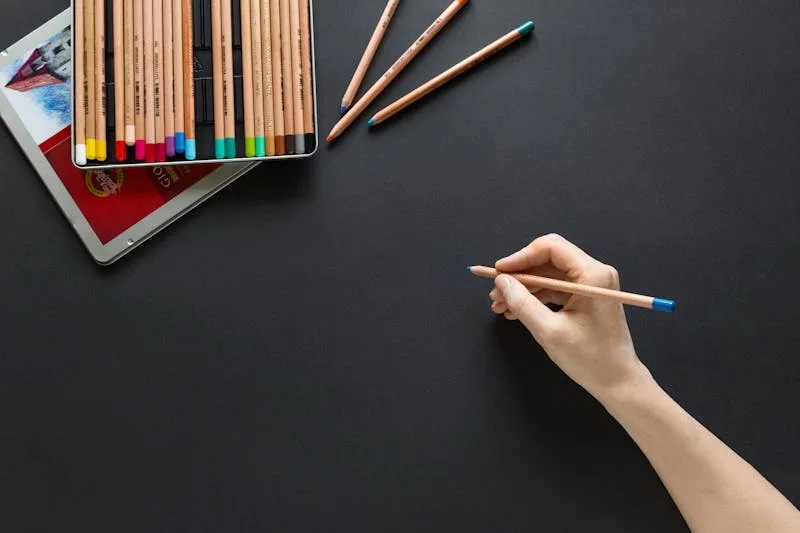
Japan takes pencils seriously. While the rest of the world has largely moved to ballpoints and gel pens for everyday writing, Japan maintains a deep reverence for the humble pencil. Japanese elementary school students learn to write exclusively with pencils, and many adults continue using them throughout their professional lives. This cultural commitment has driven Japanese pencil manufacturers to achieve a level of quality that is unmatched anywhere in the world.
We are not exaggerating. The best Japanese pencils — the Tombow Mono 100, the Mitsubishi Hi-Uni, the Kitaboshi — represent the pinnacle of pencil engineering. The graphite cores are smoother, darker, and more consistent than anything produced in Europe or America. The cedar casings are precisely milled for comfortable sharpening. The grade consistency is so reliable that artists and draftspeople worldwide trust Japanese pencils over all alternatives.
After testing every major Japanese pencil across writing, sketching, technical drawing, and everyday use, here are our picks for the best Japanese pencils you can buy.
Our Top Picks:
- Best Overall: Tombow Mono 100
- Best for Drawing: Mitsubishi Hi-Uni
- Best Mechanical Pencil: Pentel Graph Gear 1000
- Best Value: Tombow Mono J
- Best for Writing: Kitaboshi 9900
Why Japanese Pencils Are Superior
The quality advantage of Japanese pencils comes down to three factors:
Graphite Core Technology
Japanese manufacturers use proprietary processes to refine and blend graphite with clay at extremely precise ratios. This produces cores that are smoother, more break-resistant, and more consistent across the entire grade range. A Mitsubishi Hi-Uni 2B, for example, delivers exactly the same darkness and smoothness from the first millimeter to the last — a level of consistency that cheaper pencils cannot match.
Wood Quality
The cedar used in Japanese pencils is selected and processed specifically for pencil use. Tombow and Mitsubishi both source insense cedar that sharpens cleanly, does not splinter, and has a pleasant natural fragrance. The wood is kiln-dried to precise moisture levels to ensure stability in varying climates.
Quality Control
Japanese manufacturing culture demands near-perfect consistency. Each pencil is tested and inspected to standards that would seem excessive by Western manufacturing norms. The result is that every pencil in a box performs identically — no dead spots, no gritty patches, no variation in hardness.
1. Tombow Mono 100 — Best Overall
Approx. ~$18 (12-pack) | Rating: 4.9/5 | Best For: The finest all-around pencil for writing, drawing, and drafting
The Tombow Mono 100 is widely regarded as the finest pencil in the world, and after years of daily use, we agree. This is the pencil that other pencils aspire to be. The graphite core is extraordinarily smooth — it glides across paper with a buttery consistency that makes writing feel effortless. There is no scratchiness, no grittiness, no inconsistency. Just pure, refined graphite performance.
Tombow uses a proprietary high-density graphite formula for the Mono 100 that produces darker lines than competing pencils at the same grade designation. A Mono 100 HB writes noticeably darker than a standard HB from Faber-Castell or Staedtler. This density also means less graphite dust and less smudging, which keeps your paper and hands cleaner.
The Mono 100 is available in 17 grades, from 6H (extremely hard, light) to 6B (extremely soft, dark). The full grade range is useful for artists and draftspeople, but for everyday writing, we recommend HB or B — both produce dark, readable lines with minimal pressure. The B grade is particularly satisfying for journal writing and note-taking.
The iconic gold-and-black barrel is not just aesthetic — the lacquer finish is smooth and comfortable, with a slight warmth to the touch that plastic-coated pencils cannot replicate. The pencil sharpens beautifully, producing clean, even shavings without splitting or chipping.
Key Features
- High-density graphite core for exceptional smoothness
- 17 available grades (6H to 6B)
- Premium incense cedar casing
- Iconic gold-and-black lacquer finish
- Break-resistant core bonded to casing
- Consistent performance from first use to last
Why It’s Our Top Pick
The Mono 100 earns the top spot because it excels at everything. It is a superb writing pencil, a trusted drawing pencil, and a reliable drafting pencil. The quality is consistent across every grade and every individual pencil. At roughly $1.50 per pencil, it is not cheap by pencil standards, but the performance justifies the premium.
If you buy one pencil from this list, make it a box of Mono 100s in HB or B. You will immediately understand why pencil enthusiasts consider this the benchmark against which all others are measured.
Check Price on Amazon (12-Pack)
2. Mitsubishi Hi-Uni — Best for Drawing
Approx. ~$20 (12-pack) | Rating: 4.8/5 | Best For: Artistic drawing, sketching, and shading
The Mitsubishi Hi-Uni is the Mono 100’s great rival, and the debate over which is “better” has raged in pencil communities for decades. In our assessment, they are both outstanding, with the Hi-Uni having a slight edge for drawing and the Mono 100 being marginally better for writing. But the differences are subtle enough that personal preference will be the deciding factor for most users.
The Hi-Uni’s graphite is formulated for exceptional smoothness and deep, rich darkness in the softer grades. A Hi-Uni 4B or 6B lays down velvety, intensely dark graphite that is ideal for expressive sketching and dramatic shading. Artists frequently choose the Hi-Uni for this reason — the softer grades perform with a richness that few pencils can match.
Mitsubishi offers the Hi-Uni in an industry-leading 22 grades, from 10H to 10B. This is the widest grade range available in any single pencil line. For artists who need extreme precision (architectural drafting in 9H) or extreme expressiveness (gestural drawing in 8B or 10B), the Hi-Uni is the only pencil that covers the full spectrum.
The burgundy-and-gold barrel is elegant and distinctive — you will never mistake a Hi-Uni for another pencil. The lacquer finish is immaculate, and the wood sharpens as cleanly as the Mono 100’s. Core bonding is excellent, with virtually no breakage during sharpening or use.
Key Features
- Ultra-smooth graphite with rich darkness in soft grades
- Industry-leading 22 grades (10H to 10B)
- Premium incense cedar casing
- Distinctive burgundy-and-gold finish
- Excellent point retention
- Preferred by professional artists worldwide
Best for Artists
If you are primarily a drawer or sketcher, the Hi-Uni is our recommendation. The soft grades (2B through 6B) are particularly exceptional — they produce smooth, layerable graphite that blends beautifully. For a complete artist’s setup, we recommend the Hi-Uni Art Set, which includes a curated selection of grades specifically chosen for sketching and shading.
Check Price on Amazon (12-Pack)
3. Pentel Graph Gear 1000 — Best Mechanical Pencil
Approx. ~$12 | Rating: 4.7/5 | Best For: Technical drawing, detailed writing, and precision work
While this list focuses primarily on traditional wooden pencils, we would be remiss not to include the best mechanical pencil from Japan’s most renowned mechanical pencil maker. The Pentel Graph Gear 1000 is a professional-grade drafting pencil that combines precision engineering with everyday usability.
The Graph Gear 1000 features a metal body with a knurled grip section that provides excellent control and prevents hand slippage. The retractable lead sleeve protects the tip when not in use — press the click mechanism once to advance lead and extend the sleeve, press the clip to retract both. This design makes it pocket-safe without requiring a cap.
Lead advance is precise and consistent. Each click delivers approximately 0.5mm of lead (in the 0.5mm model), and the mechanism feels solid and well-engineered. There is no wobble in the lead, no play in the mechanism — the Graph Gear 1000 feels like a precision instrument, because it is one.
The pencil is available in four lead sizes: 0.3mm, 0.5mm, 0.7mm, and 0.9mm. For general writing, 0.5mm is the most versatile. For detailed technical work, 0.3mm provides extraordinary precision. The 0.7mm and 0.9mm options are better for those who prefer bolder lines or tend to break thinner leads.
For more mechanical pencil recommendations, see our Best Japanese Mechanical Pencils guide.
Key Features
- Metal body with knurled grip for precision control
- Retractable lead sleeve for pocket safety
- Available in 0.3mm, 0.5mm, 0.7mm, and 0.9mm
- Precise lead advance mechanism
- Built-in lead grade indicator on the barrel
- Under-cap eraser
- Professional drafting quality
The Professional’s Choice
The Graph Gear 1000 is the mechanical pencil that engineers, architects, and technical illustrators reach for. Its precision, durability, and ergonomics make it a tool you can rely on for demanding technical work. But it is equally at home for everyday writing and note-taking — the comfortable grip and retractable tip make it a practical daily carry.
4. Tombow Mono J — Best Value
Approx. ~$6 (12-pack) | Rating: 4.5/5 | Best For: Everyday writing and students on a budget
The Tombow Mono J sits just below the Mono 100 in Tombow’s lineup, offering the same core technology at a more accessible price point. The graphite is the same high-quality formulation, though the grade range is narrower (H through 6B) and the barrel finish is simpler — a clean olive-green lacquer without the Mono 100’s gold accents.
At roughly fifty cents per pencil, the Mono J is the best-value premium pencil you can buy. The writing experience is nearly identical to the Mono 100 in the commonly used grades (HB through 2B). The graphite is smooth, consistent, and dark. The cedar casing sharpens cleanly. The core bonding prevents breakage. You lose the Mono 100’s luxurious finish and widest-range grades, but you gain an excellent pencil at a fraction of the price.
For students, the Mono J is our top recommendation. It delivers Japanese pencil quality at a price that does not sting when pencils are lost, borrowed, or consumed by heavy use. A 12-pack will last an entire semester of daily note-taking.
Key Features
- Same high-quality graphite as the Mono 100
- Available in grades H through 6B
- Premium cedar casing
- Clean olive-green lacquer finish
- Excellent value at ~$0.50 per pencil
- Ideal for students and everyday use
Check Price on Amazon (12-Pack)
5. Kitaboshi 9900 — Best for Writing
Approx. ~$8 (12-pack) | Rating: 4.4/5 | Best For: Pure writing pleasure with a classic pencil feel
The Kitaboshi 9900 is the pencil for pencil purists. While Tombow and Mitsubishi compete on technological sophistication, Kitaboshi focuses on the fundamental pleasure of writing with a well-made pencil. The 9900 has a slightly different character from its competitors — it is a touch grittier, a touch more “pencil-like” in its tactile feedback. Some writers strongly prefer this because it provides more sensory connection to the paper.
The graphite formula is excellent, though different in character from the Mono 100 and Hi-Uni. Where those pencils emphasize buttery smoothness, the Kitaboshi 9900 has a pleasant tooth — a fine, consistent texture that provides feedback without being scratchy. For long writing sessions, this feedback can actually reduce fatigue because you are more aware of your pressure and can adjust naturally.
The cedar casing is aromatic — Kitaboshi’s cedar has a pronounced, pleasant smell that many users find nostalgic and enjoyable. Sharpening a Kitaboshi pencil is a small sensory pleasure in itself.
Key Features
- Distinctive writing feel with pleasant tactile feedback
- High-quality graphite with good darkness
- Aromatic cedar casing
- Classic hexagonal barrel
- Available in HB and B
- Excellent for extended writing sessions
Japanese Pencils vs. International Competitors
Tombow Mono 100 vs. Staedtler Mars Lumograph
The Staedtler Mars Lumograph is the most popular premium pencil outside Japan and a worthy competitor. In our head-to-head testing, the Mono 100 is smoother in every grade, produces darker lines at equivalent grades, and sharpens more cleanly. The Lumograph has a slightly grittier feel that some prefer, and it is more widely available in Western art supply stores. Both are excellent, but the Mono 100 has the edge on pure graphite quality.
Mitsubishi Hi-Uni vs. Blackwing
The Blackwing (made by Palomino/CalCedar) has a passionate following, particularly in the US. The Blackwing’s graphite is smooth and dark, with a distinctive cedar fragrance. However, it comes in only three grades (roughly HB, B, and 2B equivalent), compared to the Hi-Uni’s 22. The Blackwing’s unique flat eraser is convenient, but it inflates the per-pencil cost significantly. For artists who need grade variety and consistency, the Hi-Uni is the better choice. For casual writers who value the Blackwing aesthetic and ritual, it remains a fine pencil.
| Feature | Tombow Mono 100 | Mitsubishi Hi-Uni | Staedtler Lumograph | Blackwing |
|---|---|---|---|---|
| Grades Available | 17 (6H-6B) | 22 (10H-10B) | 16 (6H-8B) | 3 |
| Smoothness | Exceptional | Exceptional | Very Good | Very Good |
| Darkness (at HB) | Dark | Dark | Medium | Medium-Dark |
| Price (per pencil) | ~$1.50 | ~$1.67 | ~$1.25 | ~$2.50 |
| Best For | All-around use | Drawing/Art | Drafting | Casual writing |
Choosing the Right Pencil Grade
Understanding pencil grades is essential for getting the most from Japanese pencils. Here is a quick guide:
For Writing
- HB: The standard “middle” grade. Good all-around darkness with reasonable smudge resistance.
- B: Slightly softer and darker than HB. Our top recommendation for everyday writing — the increased darkness improves readability with minimal smudging trade-off.
- 2B: Noticeably soft and dark. Excellent for bold writing and journaling, but smudges more easily.
For Drawing
- H to 2H: Light lines for initial sketching and construction lines.
- HB to B: Medium tones for general drawing.
- 2B to 4B: Rich, dark tones for shading and expressive work.
- 6B to 10B: Very soft, very dark graphite for dramatic shading and gestural drawing.
For Technical Drafting
- 2H to 4H: Hard, precise lines that resist smudging.
- H: Slightly softer, for visible construction lines.
- F: A grade between H and HB (the “F” stands for “fine point”), popular in Japanese drafting.
Pencil Care Tips
Sharpening
Invest in a quality sharpener. We recommend the Uni KH-20 long-point sharpener for wooden pencils — it produces a long, elegant point that writes smoothly and lasts. For mechanical pencils, use lead that matches your pencil’s size exactly.
Storage
Store pencils in a pencil case or roll to protect the points. Avoid extreme temperatures, which can cause the wood to expand or contract and potentially crack the core bonding.
Paper Pairing
Japanese pencils perform best on smooth to medium-texture papers. For writing, Kokuyo Campus or Midori MD paper provides an excellent surface. For drawing, Bristol board or Strathmore drawing paper lets the graphite perform at its best. See our Japanese paper guide for detailed recommendations.
Complete your pencil kit with the best Japanese erasers and a quality Japanese notebook.
Frequently Asked Questions
Are Japanese pencils really better than European pencils?
In our extensive testing, the top Japanese pencils (Mono 100, Hi-Uni) consistently outperform the top European pencils (Staedtler Lumograph, Faber-Castell 9000) in smoothness and core consistency. The differences are subtle but noticeable, especially in the softer grades. Whether “better” justifies the slightly higher price depends on your sensitivity to pencil quality and your intended use.
What is the difference between the Tombow Mono 100 and Mitsubishi Hi-Uni?
Both are world-class pencils with different characters. The Mono 100 is fractionally smoother across most grades and slightly darker at equivalent hardness levels. The Hi-Uni has a wider grade range (22 vs. 17) and slightly richer graphite in the softest grades (4B and above). For writing, we give the edge to the Mono 100. For drawing, the Hi-Uni. Both are exceptional.
Do I need a special sharpener for Japanese pencils?
Not strictly necessary, but a good sharpener makes a significant difference. Japanese pencil wood is high-quality cedar that responds well to sharp blades. A quality hand sharpener (like the Uni KH-20 or a brass bullet sharpener) will produce clean, even points without breaking the core. Avoid cheap plastic sharpeners with dull blades, which can chew up the wood and break the graphite.
Are Japanese mechanical pencils better than traditional wooden pencils?
They serve different purposes. Mechanical pencils (like the Pentel Graph Gear 1000 or the pencils in our mechanical pencils guide) offer consistency — the line width never changes, and you never need to sharpen. Traditional wooden pencils offer a tactile writing experience, line variation through pressure, and a connection to the writing process that mechanical pencils cannot replicate. Many enthusiasts use both.
What grade should I choose for everyday writing?
For most people, B is the ideal writing grade. It is dark enough for easy readability, smooth enough for comfortable writing, and firm enough to maintain a point through a reasonable amount of writing before resharpening. HB is the safer choice if you are concerned about smudging or if you write with heavy pressure.
Final Verdict
Japanese pencils represent the pinnacle of a 400-year-old technology. The Tombow Mono 100 and Mitsubishi Hi-Uni set a standard that no other country’s pencils consistently match. Whether you write, draw, draft, or simply appreciate the pleasure of a perfectly made tool, Japanese pencils deliver an experience that digital alternatives cannot replicate.
Our top recommendation is the Tombow Mono 100 in B grade for its extraordinary smoothness, rich darkness, and flawless consistency. For artists, the Mitsubishi Hi-Uni offers the widest grade range and exceptional soft-grade performance. And for students or value-seekers, the Tombow Mono J delivers 90% of the Mono 100’s performance at a third of the price.
Check Mono 100 Price on Amazon | Check Hi-Uni Price on Amazon | Check Graph Gear 1000 Price on Amazon
For more writing instrument recommendations, see our Best Japanese Mechanical Pencils and Best Japanese Erasers.