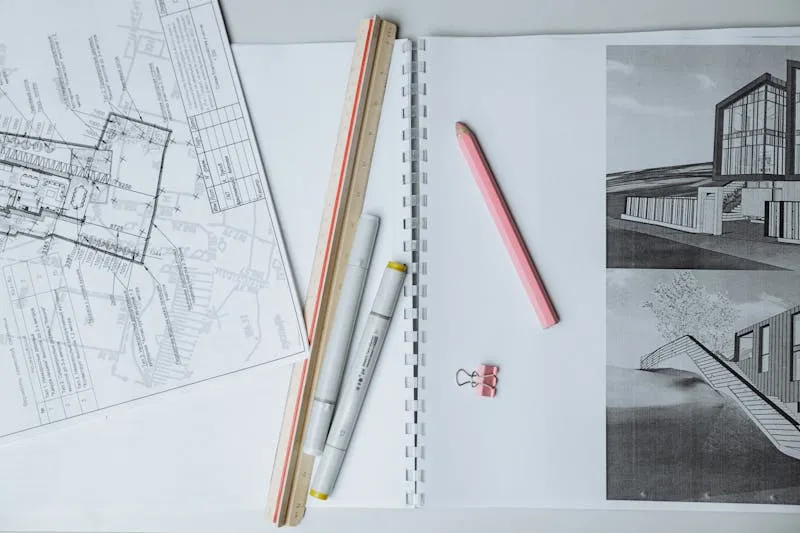
A good ruler might seem like a simple tool, but Japanese stationery manufacturers have managed to innovate even here. From ultra-thin aluminum rulers that double as bookmarks to flexible templates that create perfect circles and boxes in your bullet journal, Japanese rulers and templates add precision to your stationery workflow without adding bulk.
We use rulers and templates daily — for drawing section dividers in notebooks, creating planner layouts, and keeping handwritten tables aligned. Here are the tools that have earned permanent spots in our pencil cases.
Best Overall Ruler: Midori Aluminum Ruler (15cm)
Price: ~$8 | Material: Aluminum | Length: 15cm (6 inches)
The Midori Aluminum ruler is impossibly thin — just 1.5mm — yet it’s rigid, precise, and beautiful. The slim profile means it slides into any notebook, planner, or pencil case without adding bulk. The matte aluminum surface resists fingerprints and develops a subtle patina over time.
The non-slip rubber backing prevents the ruler from sliding on paper during use. Markings are etched (not printed), so they’ll never wear off. Both metric and imperial measurements are included, with clear, easy-to-read numbering.
At 15cm (6 inches), it’s the right length for notebook work — long enough for page-width lines in A5 and B5 notebooks, short enough to fit in a pencil case.
Pros:
- Ultra-thin (1.5mm) — fits anywhere
- Non-slip rubber backing
- Etched markings (permanent)
- Beautiful aluminum construction
- Both metric and imperial markings
Cons:
- Only 15cm — too short for A4 full-width lines
- Aluminum can scratch some surfaces
- No built-in template features
- Expensive for a ruler (~$8)
Best Budget Ruler: Kokuyo True Ruler
Price: ~$4 | Material: Acrylic | Length: 15cm
The Kokuyo True Ruler addresses a subtle problem with traditional rulers: the measurement line is offset from the paper surface by the ruler’s thickness, causing parallax error. The True Ruler’s angled edge places the measurement markings directly against the paper, ensuring accurate measurements regardless of viewing angle.
It’s a small innovation that makes a meaningful difference for precise work. The acrylic construction is lightweight and transparent, allowing you to see your work beneath the ruler.
Pros:
- Parallax-free measurement (angled edge)
- Transparent acrylic
- Accurate markings
- Affordable at ~$4
- Lightweight
Cons:
- Acrylic scratches over time
- No non-slip backing
- Printed markings (can wear with heavy use)
- Basic appearance
Best Flexible Ruler: Kokuyo Flexible Ruler
Price: ~$3 | Material: Soft plastic | Length: 15cm or 30cm
This ruler bends. It won’t snap if you toss it in a bag, sit on it, or accidentally step on it. For students and people who carry rulers in their bags daily, the flexibility is a genuine practical advantage. Despite being flexible, it straightens perfectly for accurate line drawing.
The soft plastic is also gentler on notebook pages than rigid rulers — no risk of accidentally denting thin paper.
Pros:
- Flexible — won’t break
- Gentle on paper
- Available in 15cm and 30cm
- Very affordable
- Fun to use
Cons:
- Can flex during use if not held firmly
- Printed markings
- Not suitable for cutting (blade would damage it)
- Less precise than rigid rulers for technical work
Best Template: Kutsuwa Hi-Line Template
Price: ~$5 | Material: Clear plastic | Features: Circles, ovals, squares, various shapes
For bullet journal creators and planner decorators who want perfect shapes without freehand wobble, the Kutsuwa Hi-Line template provides cutout guides for circles, ovals, squares, rectangles, and triangles in multiple sizes.
The clear plastic lets you position the template precisely over your work. The cutouts are smooth-edged for clean pen tracking. It’s small enough to fit in a pencil case but comprehensive enough to cover most common shapes.
Pros:
- Wide variety of shapes and sizes
- Clear plastic for precise positioning
- Smooth cutout edges
- Compact size
- Affordable
Cons:
- Shapes are fixed sizes (no adjustability)
- Small shapes may be too small for some uses
- Plastic can crack if bent
- Template tracing requires a fine-tip pen for best results
Best for Bullet Journaling: Midori Book Band Ruler
Price: ~$10 | Material: Brass + elastic band
This ruler attaches to your notebook via an elastic band, creating a built-in measuring tool that’s always accessible. Open your notebook and the ruler is right there — no digging through your pencil case. Close the notebook and the ruler lies flat against the cover.
The brass construction from Midori’s brass line adds a touch of elegance. It develops a warm patina over time that makes it feel personal and lived-in. The 15cm length covers most notebook widths.
Bullet journal enthusiasts particularly love this because layout creation requires frequent ruler use. Having the ruler permanently attached to the notebook eliminates a small but repeated friction point.
Pros:
- Always attached to your notebook
- Brass construction with developing patina
- Doesn’t add significant thickness
- 15cm length suits most notebooks
- Beautiful aesthetics
Cons:
- Elastic band may stretch over time
- Brass can mark paper if dragged
- Only works with notebooks (not loose paper)
- Premium price for a ruler (~$10)
Best Stencil Set: Midori Clip Ruler (with Stencil)
Price: ~$6 | Material: Stainless steel
A multi-function tool that combines a ruler, stencil, and clip in a compact form factor. The stencil portion includes shapes (circles, hearts, stars, arrows) that add decorative elements to planners and journals. The clip function attaches it to a notebook page for quick access.
This is the Swiss Army knife of notebook rulers — it does multiple things adequately rather than one thing perfectly. For people who want a single tool that handles measuring, decorating, and page-marking, it’s a clever solution.
Pros:
- Three functions in one tool (ruler, stencil, clip)
- Stainless steel durability
- Compact enough for any pencil case
- Decorative stencil shapes
- Clips to notebook pages
Cons:
- Ruler is very short (~7cm)
- Stencil shapes are small
- Jack-of-all-trades, master of none
- Metal edges can damage paper if dragged carelessly
Best for Technical Drawing: Staedtler Mars Matic Template
Price: ~$8 | Material: Tinted plastic | Features: Circles, squares, hexagons, engineering shapes
While Staedtler is German, not Japanese, their templates are widely used in Japan’s engineering and architecture schools. The Mars Matic series includes precision templates for technical drawing: circles from 1mm to 36mm, squares, hexagons, isometric circles, and engineering symbols.
For technical work that demands precision, these templates are the standard. The tinted plastic reduces glare and the engraved markings are permanent.
Pros:
- Professional-grade precision
- Wide range of technical shapes
- Tinted plastic reduces glare
- Engraved, permanent markings
- Industry standard for technical drawing
Cons:
- Larger than notebook-friendly rulers
- Overkill for casual use
- Multiple templates needed for full shape coverage
- More expensive than casual templates
How to Use Rulers and Templates in Your Notebook
Creating Section Dividers
Use a ruler and a fine-tip pen (0.3-0.4mm) to draw clean horizontal lines between sections in your notebook. This visual separation makes reviewing notes easier and more pleasant. Draw lines in a lighter color (gray or light blue) so they organize without dominating.
Building Planner Layouts
Templates make planner decoration faster and more consistent. Use circle templates for habit tracker bubbles, square templates for checkbox lists, and straight rulers for calendar grids.
Neat Tables and Charts
For vocabulary tables in language study notebooks, a ruler ensures columns align cleanly. Draw vertical column dividers with the ruler, then fill in content freehand. The combination of ruled structure and handwritten content looks professional and organized.
Frequently Asked Questions
Is a 15cm ruler long enough?
For notebook work (A5 and B5), 15cm covers the page width. For A4 or US Letter paper, you’ll need a 30cm ruler. Most people find 15cm sufficient for daily stationery use.
Do aluminum rulers scratch notebook pages?
Quality aluminum rulers (like the Midori) are smooth and generally safe for notebook use. The rubber backing on the Midori prevents scratching during normal use. Avoid dragging the edge under heavy pressure on thin paper.
Can I use templates with any pen?
Fine-tip pens (0.3-0.5mm) work best with templates because the tip follows the template edge precisely. Bold tips extend beyond the template edge, producing less accurate shapes. Pencils work well too. Brush pens and markers are too imprecise for template work.
Are brass rulers practical or just decorative?
Both. The Midori brass ruler is genuinely functional — accurate markings, appropriate length, durable construction. The developing patina is a bonus that makes a practical tool beautiful. It’s not a choice between function and aesthetics — Japanese design provides both.
What ruler should a student carry?
The Kokuyo Flexible Ruler (15cm) is the best student ruler: inexpensive, unbreakable, and accurate enough for all school tasks. Students who also do creative journaling should add the Kutsuwa template for shape drawing.