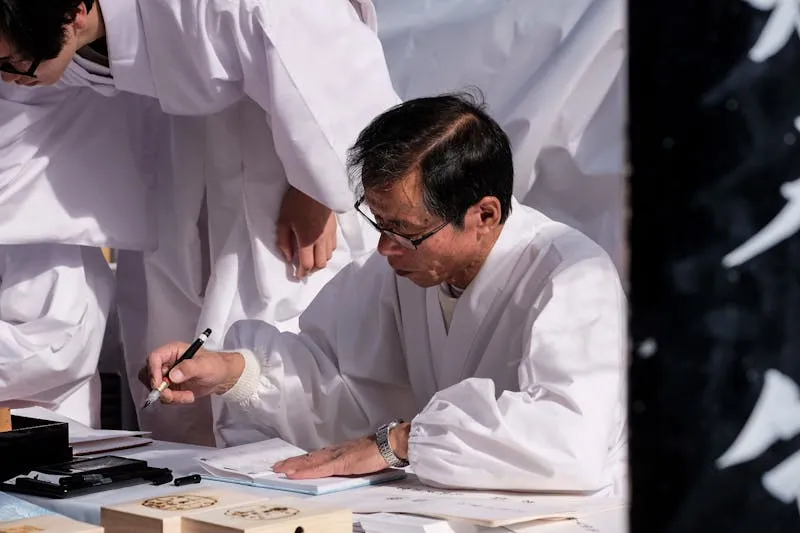
Japanese calligraphy — shodo (書道, “the way of writing”) — is more than beautiful handwriting. It’s a meditative practice that combines art, discipline, and cultural expression. Each brushstroke is a single, unrepeatable moment of intention. There’s no undo, no correction, no second chance. This commitment to the present moment gives shodo its distinctive power and beauty.
You don’t need to be artistic to begin. Living in Japan, we’ve watched elementary school students practice shodo as part of their standard curriculum. The basics are accessible to anyone willing to sit, breathe, and apply brush to paper. Here’s everything you need to start.
The Four Treasures of the Study (文房四宝)
Japanese calligraphy supplies are traditionally organized around the bunbo shiho — the “four treasures of the study”:
1. Brush (筆 / Fude)
Budget: $8-15 (beginner) | $20-50 (quality)
The calligraphy brush is your primary tool. Beginner brushes are typically made with goat hair (soft, absorbent) or a blend of goat and weasel/horse hair (medium firmness). The hair is set in a bamboo handle.
For beginners, we recommend:
Kuretake Large Brush — A well-balanced medium-sized brush suitable for standard character practice. The mixed-hair construction provides enough softness for smooth strokes while maintaining enough firmness for control. About $12.
Sizing guide:
- Large (太筆 / futofude): For full-size characters (3-4 inches) — the standard practice brush
- Medium: For smaller characters and more detailed work
- Small (小筆 / kofude): For fine detail, addresses, and small characters
Start with one large brush and one small brush. The large brush teaches fundamental stroke technique. The small brush handles practical tasks like writing names and addresses.
2. Ink (墨 / Sumi)
Budget: $5-10 (liquid ink) | $10-30 (ink stick)
Liquid Ink (墨汁 / bokuju): Pre-mixed liquid sumi ink is the practical choice for beginners. It’s ready to use immediately — pour into your ink stone or dish and start writing. Kuretake and Pilot both make excellent liquid sumi ink.
Ink Stick (墨 / sumi): Traditional solid ink that you grind on an ink stone with water. The grinding process is meditative — 10-15 minutes of slow, circular grinding prepares both the ink and your mindset for practice. The resulting ink is generally smoother and more nuanced than liquid ink, with subtle color variations.
For beginners, start with liquid ink for convenience. Add an ink stick later when you want to experience the full traditional process.
3. Ink Stone (硯 / Suzuri)
Budget: $10-20 (beginner) | $30-100+ (quality)
The ink stone serves as both a grinding surface (for ink sticks) and an ink well (for liquid ink). Even if you use liquid ink, an ink stone provides the ideal shallow pool for loading your brush.
A basic rectangular ink stone with a smooth grinding surface and a slightly deeper well end is all you need. Avoid decorative stones with rough surfaces — they make grinding harder, not better.
Alternative: A shallow ceramic dish works as a substitute ink well for liquid ink. It lacks the grinding surface for ink sticks but is cheaper and easier to clean.
4. Paper (紙 / Kami)
Budget: $5-10 per pad
Calligraphy paper — hanshi (半紙) — is thin, absorbent paper that allows ink to flow naturally without pooling. The paper’s absorbency is part of the aesthetic: ink spreads slightly at stroke endings, creating the characteristic soft edges of brush calligraphy.
For beginners: Standard practice hanshi is affordable and disposable. Use it freely — you’ll write hundreds of practice sheets. A pack of 100 sheets costs about $5-8.
For finished pieces: Use gasen-shi (画仙紙), a higher-quality calligraphy paper with less absorbency and a smoother surface. The ink sits more crisply on gasen-shi, producing cleaner characters suitable for display.
Additional Supplies
Paperweight (文鎮 / Bunchin)
A weight placed on the paper to prevent it from moving during writing. Traditional paperweights are elongated metal bars. Any heavy, flat object works — a ruler, a book, a smooth stone.
Felt Underlay (下敷 / Shitajiki)
A black felt pad placed under your paper. It absorbs excess ink that bleeds through the thin hanshi, protects your desk surface, and provides a cushioned writing surface that improves brush feel.
Price: ~$5-10 for a standard-size felt pad
Brush Rest (筆置 / Fudeoki)
A stand for resting your brush when not actively writing. Keeps the brush tip off the desk (preventing ink transfer) and adds an aesthetic element to your calligraphy setup.
Water Dish
A small dish of clean water for rinsing your brush between characters and during cleanup. Any small ceramic or glass dish works.
Complete Beginner Set
For the easiest start, buy a complete calligraphy set:
Kuretake Calligraphy Set (includes brush, ink, ink stone, paperweight, felt pad, and practice paper)
Price: ~$25-35
This is the most practical way to start — everything you need in one purchase, with quality-matched components. Kuretake is Japan’s leading calligraphy supply manufacturer, and their beginner sets are thoughtfully assembled.
Basic Techniques
Holding the Brush
Hold the brush vertically (perpendicular to the paper), gripping the handle between your thumb, index, and middle fingers, with the ring and pinky fingers supporting from below. Your wrist should be slightly elevated, with movement coming from the arm and shoulder, not the fingers.
This vertical position is fundamentally different from how you hold a pen. It takes practice to feel natural, but it’s essential for proper stroke execution.
The Eight Basic Strokes
All kanji are constructed from combinations of eight basic strokes:
- Horizontal stroke (横画 / yokaku) — Left to right
- Vertical stroke (縦画 / jugaku) — Top to bottom
- Left-falling stroke (左はらい / hidari harai) — Diagonal, upper-right to lower-left
- Right-falling stroke (右はらい / migi harai) — Diagonal, upper-left to lower-right
- Dot (点 / ten) — Short press and lift
- Hook (はね / hane) — Stroke ending with an upward flick
- Turning stroke (折れ / ore) — Direction change within a stroke
- Curving stroke (曲がり / magari) — Gradual curve
Practice each stroke individually before attempting full characters. The character 永 (ei, eternity) contains all eight basic strokes and is the traditional first practice character.
Practice Progression
- Stroke practice — Master each stroke type independently (1-2 weeks)
- Simple characters — Practice characters with few strokes: 一 (one), 二 (two), 三 (three), 大 (big), 日 (day), 月 (moon)
- Standard characters — Progress to more complex characters following kanji practice stroke order
- Composition — Write full words and phrases with consistent style
- Creative work — Develop personal style and create display pieces
Connecting Calligraphy to Your Stationery Practice
Using Brush Pens Instead of Traditional Brushes
If traditional brushes feel intimidating, brush pens provide a gentler entry point. The Pentel Fude Touch Sign Pen mimics brush behavior with the convenience of a pen. Use it for kanji practice that incorporates calligraphic awareness.
Calligraphy in Journaling
Add calligraphic elements to your bullet journal or planner: brush-lettered month headers, Japanese characters as decorative elements, or haiku written in brush style.
Frequently Asked Questions
Is Japanese calligraphy hard to learn?
The basics are accessible to anyone. Producing beautiful, balanced characters takes practice — months to years depending on your goals. The learning curve is similar to any artistic skill: early progress is fast, refinement is gradual. Most people produce satisfying characters within a few weeks of consistent practice.
How is Japanese calligraphy different from Chinese calligraphy?
Japanese shodo uses the same basic tools and many shared characters (kanji originated in China), but styles have diverged over centuries. Japanese calligraphy includes hiragana and katakana writing, which have flowing, cursive characteristics distinct from Chinese calligraphy. Japanese styles also tend to emphasize simplicity and negative space (influenced by Zen aesthetics).
How often should I practice?
15-30 minutes, 3-5 times per week produces steady improvement. Daily practice is ideal but not necessary. The meditation aspect of calligraphy makes even short sessions beneficial for stress reduction and focus development.
Can I do calligraphy with a regular brush?
Technically, but calligraphy brushes are purpose-built. They hold more ink, release it more consistently, and come to a finer point than standard paintbrushes. The investment in a proper calligraphy brush ($10-15) is small and makes a significant difference in the experience.
Where can I take calligraphy classes?
Japanese cultural centers in major US cities often offer shodo classes. Community education programs, art centers, and university continuing education departments sometimes include calligraphy workshops. Online video instruction is also available and effective for self-study.