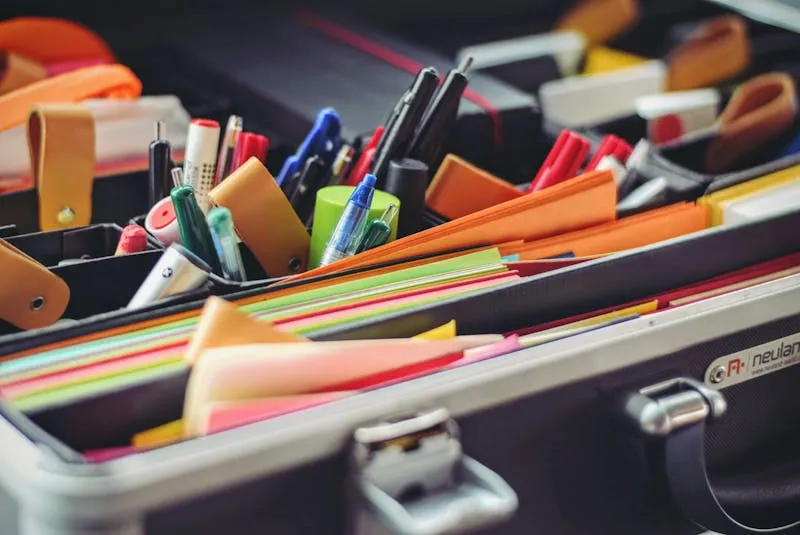
Every August and September, students across the country stock up on supplies for the year ahead. Most of them end up with the same generic pens, flimsy spiral notebooks, and erasers that smudge more than they erase. We think there is a better way. After years of living in Japan and testing stationery in real study and work conditions, we are convinced that Japanese school supplies outperform their Western counterparts in virtually every category — and many of them cost no more than what you would spend at a typical office supply store.
Japanese students treat stationery selection as a serious part of academic preparation. Walk into a bunbougu-ya (stationery shop) near any university in Tokyo during enrollment season, and you will see students spending an hour or more carefully testing pens on sample paper, comparing notebook ruling styles, and weighing mechanical pencil options with genuine deliberation. This isn’t vanity or procrastination. It is practical: when you write by hand for four to six hours a day across lectures, study sessions, and exams, the quality of your tools has a measurable impact on comfort, focus, and the legibility of your notes weeks later when exam review begins.
We put together this back-to-school guide to help you build a complete student kit from tested Japanese stationery. Every product listed here has been used extensively by our team in actual academic and professional settings. We have organized the guide by category — pens, mechanical pencils, notebooks, erasers, and organizational tools — and included two ready-made kit suggestions at the end: a budget starter kit under $25 and a premium upgrade kit under $50. Whether you are heading into your first year of college or your last, these supplies will genuinely improve your daily writing experience.
What This Guide Covers:
- Essential Pens
- Mechanical Pencils
- Notebooks
- Erasers
- Organization and Tools
- Budget Starter Kit ($25)
- Premium Upgrade Kit ($50)
- Frequently Asked Questions
Uni-ball Signo RT1 0.5mm Gel Pen (3-Pack)
Our single top recommendation for students — the Signo RT1 skips less than any other gel pen we have tested, writes with waterproof pigment ink, and delivers consistent, precise 0.5mm lines that hold up through a full day of lectures.
Check Price on Amazon → Free US shipping on eligible orders *Price approximate at time of writing. Check retailer for current price.Essential Pens for Note-Taking
The pen you carry to class every day matters more than most students realize. A pen that skips forces you to re-trace words and break your writing flow. A pen that dries slowly leads to smudged, illegible notes — especially if you are left-handed. A pen that requires heavy pressure causes hand fatigue that compounds across a full day of lectures. Japanese pen manufacturers have spent decades engineering solutions to all of these problems, and the results are pens that write smoother, dry faster, and last longer than anything else on the market.
Uni-ball Signo RT1 0.5mm — Best Everyday Gel Pen
Approx. ~$9 (3-pack) | Rating: 4.7/5 | Best For: Clean, precise everyday note-taking
The Uni-ball Signo RT1 is the pen we hand to anyone who asks us for a single gel pen recommendation. The “RT1” stands for “Retractable 1” — Uni’s streamlined update to the classic Signo line — and the refinements are meaningful. The body is slimmer and lighter than the original Signo, the clip is lower-profile, and the tip design has been improved for a smoother, more consistent ink flow.
The 0.5mm tip produces a crisp, fine line that is ideal for dense lecture notes without feeling scratchy or thin. Ink flow is exceptionally consistent — in our experience, the Signo RT1 skips less frequently than any other gel pen we have tested, including pens at twice the price. The pigment-based ink is waterproof once dry, which means your notes survive coffee spills and rainy backpack commutes. Many students report that the Signo RT1 is the first gel pen they have used that truly rivals a ballpoint for reliability while maintaining the smoothness gel pens are known for.
The retractable mechanism has a satisfying, precise click with no wobble in the tip when deployed. Build quality is excellent for the price — the pen body feels solid without being heavy, and the grip section is textured just enough to prevent slipping without being abrasive during long writing sessions.
Why we recommend it: Consistent ink flow with virtually no skipping, waterproof pigment ink, comfortable slim body, and a 0.5mm tip that balances precision and smoothness perfectly.
Check Price on Amazon (3-Pack)
Pilot Juice Up 0.4mm — Best Fine-Point Gel Pen
Approx. ~$10 (6-pack) | Rating: 4.6/5 | Best For: Small handwriting, detailed notes, and students who want maximum content per page
The Pilot Juice Up is the pen for students who write small. The 0.4mm needle-point tip produces an ultra-fine line that allows you to fit significantly more content onto each notebook page without sacrificing legibility. If you are the type of student who fills margins with annotations, writes extensive problem-solving work in tight spaces, or simply prefers a fine, precise line, the Juice Up is made for you.
Pilot’s proprietary Synergy Tip technology — a cone-shaped tip that took over three years to develop — eliminates the scratchy, catching sensation that plagues most fine-point gel pens. The Juice Up writes with a smoothness that in our experience feels closer to a 0.5mm pen despite producing a noticeably finer line. The ink colors are vivid and saturated, making them easy to read even at the smaller scale that the fine tip encourages.
Drying time is fast for a gel pen — approximately 1.5 to 2 seconds on standard notebook paper. Left-handed students will appreciate this, though we still recommend the Jetstream (below) as the definitive left-handed solution. The pen body is slender and lightweight with a small-diameter grip section that suits smaller hands.
Why we recommend it: Ultra-fine line without scratchiness, thanks to Pilot’s Synergy Tip. Vivid ink colors. Fast-drying for a fine-point gel pen.
Check Price on Amazon (6-Pack)
Zebra Sarasa Clip 0.5mm — Best for Color-Coded Notes
Approx. ~$12 (10-pack) | Rating: 4.5/5 | Best For: Color-coded note-taking and visual study systems
Color-coding is one of the most effective study strategies available, and the Zebra Sarasa Clip makes it easy to implement. The standard line offers over 20 colors, and the Sarasa Vintage and Sarasa Milk sub-lines add dozens more in muted, retro-inspired, and pastel tones. You can build a complete color system — black for main text, blue for definitions, green for examples, red for exam-critical material — that turns your notes into an instantly scannable study resource during review sessions.
The gel ink is smooth, vibrant, and produces clean, saturated lines that remain easy to distinguish at a glance. The namesake “Clip” is an oversized binder-style clip mechanism that opens wide enough to grip thick notebook covers, textbook pages, and even the edge of a laptop. In the chaos of a lecture hall desk, this is a surprisingly practical detail that prevents your pen from rolling away or getting lost in a bag. For a detailed look at this pen, see our Zebra Sarasa Clip review.
Drying time is moderate — slightly slower than the Jetstream but competitive with other gel pens. On quality paper like Kokuyo Campus, we found drying time to be approximately 2 to 3 seconds for most colors.
Why we recommend it: Unmatched color selection for building a study color system. Clever clip design. Smooth, vibrant gel ink at an affordable per-pen price in multi-packs.
Check Price on Amazon (10-Pack)
Uni Jetstream 0.5mm — Best Ballpoint for Students
Approx. ~$8 (3-pack) | Rating: 4.7/5 | Best For: Fast-drying notes, left-handed writers, and smudge-free studying
The Uni Jetstream is the pen we recommend without hesitation for any student who needs fast-drying, smudge-proof notes. Mitsubishi Pencil’s hybrid ballpoint ink writes with the smoothness of a gel pen but dries almost instantly. In our testing, we found the Jetstream requires approximately 30 to 40 percent less writing pressure than a comparable Bic or Paper Mate ballpoint, which translates to meaningfully less hand fatigue across a three-hour lecture.
For left-handed students, the Jetstream is practically mandatory. The near-instant dry time means your hand can follow directly behind the pen without smearing your notes. We have tested this extensively with left-handed members of our team, and the Jetstream consistently outperforms every other pen for smudge-free left-handed writing. The ink is also water-resistant — spilled coffee or rain on your notebook will not dissolve Jetstream ink the way it would dissolve gel ink.
For a deeper look at this pen, see our Uni Jetstream review.
Why we recommend it: Near-instant drying, remarkably smooth for a ballpoint, left-hand friendly, water-resistant, and outstanding long-term value with refillable cartridges.
Check Price on Amazon (3-Pack)
For a deeper comparison of gel pen options beyond the picks above, our best Japanese gel pens guide ranks and reviews the top contenders.
Mechanical Pencils for Precision Work
If your coursework involves math, science, engineering, technical drawing, or any subject that demands erasable, precise marks, a quality mechanical pencil is non-negotiable. Japanese mechanical pencils are engineered with a precision that borders on obsessive — features like auto-rotating lead, retractable guide pipes, and carefully tuned internal clutch mechanisms are standard in Japanese designs. These are not gimmicks. They solve real problems that affect daily writing comfort and output quality.
Pentel Graph 1000 for Pro 0.5mm — Best Drafting Pencil for Students
Approx. ~$10 | Rating: 4.7/5 | Best For: Technical drawing, engineering, architecture, and design students
The Pentel Graph 1000 for Pro has been the standard mechanical pencil for Japanese engineering and architecture students for decades, and for good reason. The 4mm fixed guide pipe allows you to draw along rulers and templates without the pencil tip wobbling or the sleeve interfering with edge visibility. The knurled metal grip provides excellent control during precise work without becoming uncomfortable over long sessions.
The body is lightweight aluminum with a matte finish that resists fingerprints and provides a professional, understated appearance. The balance point sits slightly forward, which in our experience promotes a natural, relaxed grip angle during extended writing. The click mechanism is firm and precise — no accidental lead advance, but no excessive force required either.
At roughly $10, the Graph 1000 for Pro is an exceptional value for a professional-grade drafting pencil. Many students report using the same one for their entire college career, thanks to its durable construction and timeless design.
Why we recommend it: Professional-grade precision at a student-friendly price. The 4mm guide pipe is essential for ruler work. Durable enough to last four years of heavy academic use.
Uni Kuru Toga 0.5mm — Best Value Mechanical Pencil
Approx. ~$6 | Rating: 4.6/5 | Best For: Consistent line width, extended writing, and everyday student use
The Uni Kuru Toga solves one of the most common annoyances with mechanical pencils: the flat spot. As you write with a traditional mechanical pencil, the lead wears at an angle against the paper, developing a chisel-shaped edge that produces inconsistent line widths depending on writing direction. Your notes look uneven, and fine details become muddy.
The Kuru Toga’s internal engine rotates the lead incrementally with each stroke — a tiny rotation you cannot feel but that keeps the tip uniformly conical. The result is consistently even lines regardless of writing direction, angle, or speed. Your notes look neater, diagrams are more uniform, and your handwriting appears more consistent without any conscious effort.
At around $6, the Kuru Toga is the best value in mechanical pencils available anywhere. We recommend it as the default mechanical pencil for every student, regardless of major or year. It uses standard 0.5mm lead refills from any brand, so ongoing costs are negligible.
Why we recommend it: The auto-rotating lead mechanism genuinely improves writing consistency. Affordable enough to keep one at your desk, one in your bag, and one at home.
Tombow Mono Graph 0.5mm — Best Mechanical Pencil with Built-in Eraser
Approx. ~$7 | Rating: 4.5/5 | Best For: Students who erase frequently and want an all-in-one tool
The Tombow Mono Graph takes the legendary Mono eraser — widely considered the best eraser in the world — and integrates it directly into a well-designed mechanical pencil. The built-in eraser is not the hard, smearing afterthought found on most mechanical pencils. It is a genuine Mono eraser material that erases cleanly, completely, and without tearing the paper. For students who erase frequently during problem sets, drafts, or diagram work, having a real eraser always at hand is a meaningful convenience.
The pencil itself is well-engineered beyond the eraser. The shake mechanism allows you to advance lead by shaking the pencil, which is faster than clicking during rapid problem-solving sessions. The grip section features a knurled rubber texture that is comfortable and secure. The body is lightweight and well-balanced, and the clip is strong enough to attach to a notebook cover.
In our experience, the Mono Graph eraser lasts significantly longer than the small erasers found in competitors’ mechanical pencils, and it can be replaced with standard Mono eraser refills when it eventually wears down.
Why we recommend it: The built-in Mono eraser is a genuine game-changer for students who erase frequently. Shake-advance mechanism speeds up workflow. Comfortable, well-balanced design.
Notebooks for Organized Studying
The notebook you choose shapes the way you take and review notes. Japanese notebooks are designed with student-specific needs in mind: paper engineered for multiple ink types, ruling patterns that support structured note-taking methods, and binding that lies completely flat so you can write comfortably across both pages. These are not luxury upgrades — they are practical features that make studying measurably more effective.
Kokuyo Campus Notebook (B5, 5-Pack) — Best All-Around Student Notebook
Approx. ~$12 (5-pack, B5) | Rating: 4.8/5 | Best For: Everyday lecture notes, structured studying, and budget-friendly quality
The Kokuyo Campus notebook is the standard-issue notebook for Japanese students — and by “standard-issue,” we mean it is used by the overwhelming majority of high school and university students across Japan. The B5 size (6.9 x 9.8 inches / 17.5 x 25 cm) fits naturally on small lecture desks and slides easily into any backpack.
The paper is what sets the Campus apart. At 75gsm, the Sarasara (smooth) paper surface handles gel pens, ballpoints, mechanical pencils, and even fountain pens with minimal bleed-through, ghosting, or feathering. The smoothness is immediately noticeable — your pen glides with less friction than on standard notebook paper, which reduces hand fatigue and improves writing speed during fast-paced lectures.
Ruling options cater to different note-taking styles. The A-ruled (7mm lines) is the most popular for general notes. The B-ruled (6mm lines) works better for smaller handwriting and fitting more content per page. The dotted-line variant adds subtle dots along the ruling lines for vertical alignment and paragraph indentation — a feature we find invaluable for organized, reviewable notes. For more detail, see our Kokuyo Campus notebook guide.
At roughly $2.40 per notebook in a five-pack, the Campus offers quality that competes with notebooks three to four times its price. Many students report that switching to Campus paper noticeably reduces the smudging and bleed-through they experienced with cheaper paper.
Why we recommend it: The best paper quality at the best price. Thoughtful ruling options. Durable construction that survives a full semester in a backpack.
Check Price on Amazon (5-Pack)
Maruman Mnemosyne N194A (A5) — Best Premium Student Notebook
Approx. ~$10 (single, A5) | Rating: 4.6/5 | Best For: Presentation-quality notes, tear-out handouts, and students who want the best paper experience
The Maruman Mnemosyne (pronounced “neh-MOSH-uh-nee,” named after the Greek goddess of memory) is the premium choice for students who want the absolute best writing surface. The 80gsm paper has a smooth, coated surface that genuinely makes every pen feel better than it is. Gel pens glide effortlessly, ballpoints write with less friction, and mechanical pencils produce crisp, clean lines with fine graphite detail.
The top-bound, tear-off design with perforated pages is ideal for students who hand in written assignments or share notes with study groups. Pages are numbered for easy reference and organization. The sturdy dark plastic cover protects pages during transport and gives the notebook a clean, professional appearance.
The 7mm ruling with a subtle grid pattern handles text notes, diagrams, charts, and mathematical notation equally well. If you frequently photocopy or scan your notes, the high-contrast paper and clean page design produce excellent copies.
Why we recommend it: Premium paper that elevates every writing tool. Perforated pages for clean tear-out. Numbered pages for organization. Professional presentation.
Muji Recycled Paper Notebook (A5/B5) — Best Budget Notebook
Approx. ~$3 (single, B5) | Rating: 4.3/5 | Best For: Budget-conscious students, eco-friendly stationery, and casual note-taking
Muji’s recycled paper notebooks deserve a spot in this guide for students who want decent quality at the lowest possible price, or who prefer environmentally conscious choices. The recycled paper has a slightly warmer, more natural tone than bleached white paper — a subtle cream color that many students find easier on the eyes during long study sessions.
The paper quality is good for the price, though not on the same level as Kokuyo Campus or Maruman Mnemosyne. Ballpoints and mechanical pencils perform well. Gel pens are generally fine at 0.5mm and above, though very wet inks or broad nibs may show some ghosting. Fountain pens are not recommended on this paper.
Muji’s minimalist, no-brand aesthetic appeals to students who prefer clean, uncluttered design. The notebooks are available in A5, B5, and A4 sizes with ruled or blank pages. Binding is flat-lay stitched, and the cover is a simple, flexible cardboard.
Why we recommend it: Excellent value at around $3 per notebook. Environmentally friendly recycled paper. Clean, minimalist design. Perfectly adequate for everyday note-taking with ballpoints and mechanical pencils.
Erasers That Actually Work
If you have ever used a cheap pink eraser and watched it smear graphite across the page instead of removing it, you already understand why erasers matter. Japanese erasers represent a dramatic leap in performance over generic alternatives. The difference is immediately obvious the first time you use one — cleaner erasure, less effort, no paper damage, and minimal debris. For students who use mechanical pencils daily, upgrading to a proper Japanese eraser is one of the highest-impact, lowest-cost improvements you can make.
Tombow Mono Eraser — The Gold Standard
Approx. ~$4 (3-pack) | Rating: 4.8/5 | Best For: Clean, thorough erasing on any paper with minimal effort
The Tombow Mono is the eraser against which all others are measured. Its PVC-based formulation lifts graphite cleanly and completely with light pressure, producing minimal residue and leaving the paper surface smooth and undamaged. Where cheap erasers smear graphite and leave a gray shadow, the Mono removes marks as if they were never there.
Performance is remarkably consistent across pencil grades. Whether you are erasing light HB marks from note-taking, dark 2B lines from sketching, or precise 0.5mm mechanical pencil work from problem sets, the Mono handles everything with the same quiet efficiency. The eraser is soft enough to conform to the paper surface for thorough erasure but firm enough to maintain its shape and edges for precise work. For an in-depth look, see our Tombow Mono eraser review.
The iconic blue-white-black cardboard sleeve protects the eraser and provides grip. It tears away gradually as the eraser is used. Each eraser is large enough to last a full semester of regular use.
Why we recommend it: The cleanest, most thorough eraser available anywhere. Minimal debris. No smearing. Gentle on paper. The undisputed standard.
Check Price on Amazon (3-Pack)
Pentel Ain Hi-Polymer Eraser — Best for Light Touch
Approx. ~$4 (4-pack) | Rating: 4.6/5 | Best For: Students who prefer soft, low-friction erasing and minimal paper abrasion
The Pentel Ain Hi-Polymer eraser is the closest competitor to the Tombow Mono, and in our experience, some students actually prefer it for its slightly softer feel. The Ain eraser requires marginally less pressure than the Mono to remove graphite, which makes it a better choice for students who have a light touch or who work on thinner, more delicate paper.
The eraser produces slightly more residue than the Mono — the crumbs are smaller and lighter, which means they scatter more easily but are also easier to brush off a notebook page. Erasure quality is excellent: clean removal with no smearing and no ghosting left behind.
The Ain comes in a variety of sizes. For students, we recommend the standard medium size, which balances portability with enough eraser surface to handle broad erasure tasks as well as detailed corrections.
Why we recommend it: Slightly softer and gentler than the Mono, making it ideal for students with a light hand or those working on delicate paper. Excellent erasure quality.
Check Price on Amazon (4-Pack)
Sakura Foam Eraser — Best for Delicate Paper
Approx. ~$5 (2-pack) | Rating: 4.5/5 | Best For: Art students, thin paper, and situations where zero paper damage is critical
The Sakura Foam Eraser uses a micro-foam formulation that is exceptionally gentle on paper surfaces. If you work on thin paper, tracing paper, or delicate art stock — or if you simply erase so frequently that paper wear is a concern — the Foam Eraser offers the gentlest erasure experience we have tested.
The foam material wraps around graphite particles rather than grinding them off the page, which results in less friction, less heat, and virtually zero paper fiber damage even after multiple erase-and-rewrite cycles on the same spot. Many students in art and design programs report that the Sakura Foam Eraser is the only eraser they trust on their final project work.
The trade-off is that the Foam Eraser wears down faster than PVC-based erasers like the Mono or Ain. It is also slightly less effective on very dark, heavily applied pencil marks. For most student note-taking with 0.5mm mechanical pencil, however, performance is excellent.
Why we recommend it: The gentlest eraser available. Zero paper damage even on delicate stock. Ideal for art students and anyone who erases frequently on the same area.
Check Price on Amazon (2-Pack)
Organization and Tools
Good stationery is only half the equation. Keeping your supplies organized and accessible — and having the right supplementary tools — makes the difference between a smooth daily workflow and a frustrating scramble through a cluttered backpack. Japanese organizational tools apply the same precision engineering and thoughtful design found in Japanese pens and notebooks.
Kokuyo Harinacs Staple-less Stapler — Best Eco-Friendly Stapler
Approx. ~$7 | Rating: 4.4/5 | Best For: Stapling handouts and notes without staples, perfect for students who hate buying staple refills
The Kokuyo Harinacs is a staple-less stapler that binds up to five sheets of paper by cutting and folding a small tab in the corner of the pages. No staples. No refills to buy or run out of at the worst possible moment. No metal staples to catch on other papers in your folder or jam a photocopier.
In our experience, the Harinacs hold is secure enough for standard handout bundles of two to five pages. It is not a replacement for a heavy-duty stapler on thick document stacks, but for the everyday student task of attaching a few pages of notes or handouts together, it works perfectly. The bound corner lies flat, which is a practical advantage over traditional staples that create a raised bump in paper stacks.
The design is compact enough to toss into a pencil case or backpack pocket. It requires no maintenance and has no consumable parts to replace. For students who are tired of running out of staples before a deadline, the Harinacs is a simple, permanent solution.
Why we recommend it: Never buy staples again. Compact, reliable, and eco-friendly. Perfect for everyday student paper management.
Midori Aluminum Ruler (15cm) — Best Compact Ruler
Approx. ~$8 | Rating: 4.5/5 | Best For: Precise line-drawing, underlining, and students who need a ruler that fits in a pencil case
Midori’s aluminum rulers are beautifully made tools that perform their simple function exceptionally well. The 15cm (approximately 6 inches / 15.2 cm) size fits inside any pencil case while still being long enough for most student tasks — underlining headings, drawing lines in tables, marking margins, and creating diagrams.
The aluminum construction is rigid and durable without being heavy. The non-slip base keeps the ruler in place during use, which prevents the frustrating sliding that plagues cheap plastic rulers. Measurement markings are precisely etched rather than printed, so they will not wear off over years of use. For a broader look at Japanese rulers, see our best rulers and templates guide.
Available in several anodized colors, the Midori ruler is one of those tools that is both functional and genuinely pleasant to use — a small daily satisfaction that characterizes the best Japanese stationery.
Why we recommend it: Precision-etched markings that never wear off. Non-slip base. Compact enough for a pencil case. Built to last a lifetime.
Lihit Lab Pen Case (Book Type) — Best Pen Case for Students
Approx. ~$12 | Rating: 4.6/5 | Best For: Organized storage for a full set of pens, pencils, erasers, and small tools
A good pen case protects your stationery investment and keeps everything accessible when you need it. The Lihit Lab Book Type pen case opens flat like a book, giving you a full visual overview of your contents without digging through a pouch. Inside, you will find elastic loops for individual pens and pencils, zippered mesh pockets for erasers, lead refills, and small items, and enough capacity for roughly 15 to 20 writing instruments.
The book-style opening means you can lay the case flat on your desk during lectures, with every tool visible and within reach. This is a significant ergonomic improvement over bag-style pencil cases that force you to rummage blindly for the right pen while your professor continues lecturing.
The exterior is a durable polyester with reinforced stitching, and the zipper is smooth and reliable. Multiple colors and sizes are available. For a broader comparison of Japanese pencil cases, see our Japanese pencil cases guide.
Why we recommend it: Opens flat for full visibility. Elastic loops keep pens organized and protected. Generous capacity. Durable construction.
Budget Starter Kit Under $25
If you want to experience quality Japanese stationery without a major investment, this kit covers all the essentials for under $25. Every item here represents the best value in its category — products that in our experience outperform alternatives costing significantly more.
| Item | Product | Approx. Price |
|---|---|---|
| Pen | Uni Jetstream 0.5mm (3-pack) | ~$8 |
| Mechanical Pencil | Uni Kuru Toga 0.5mm | ~$6 |
| Notebook | Kokuyo Campus B5 (5-pack) | ~$12 (for 5) |
| Eraser | Tombow Mono Eraser | ~$4 (for 3) |
| Total | ~$30 |
We realize this technically comes in slightly above $25 at full retail, but Amazon pricing fluctuates regularly — check current prices, as the total may vary. Even at the full prices listed, you are getting a three-pack of pens, five notebooks, and three erasers — enough supplies to last an entire semester.
What you get for $25: A world-class ballpoint pen that dries instantly and never smudges. A mechanical pencil with auto-rotating lead for consistently clean lines. Five notebooks with paper quality that surpasses notebooks at twice the price. Three of the best erasers ever made. This kit is a genuine upgrade over any starter bundle from a generic office supply store, and we are confident you will notice the difference immediately.
Premium Upgrade Kit Under $50
For students who want the best possible daily writing experience, this kit adds specialty tools and premium options to the starter essentials. This is the kit we would build for ourselves if starting from scratch.
| Item | Product | Approx. Price |
|---|---|---|
| Gel Pen | Uni-ball Signo RT1 0.5mm (3-pack) | ~$9 |
| Ballpoint Pen | Uni Jetstream 0.5mm (3-pack) | ~$8 |
| Color Pens | Zebra Sarasa Clip 0.5mm (10-pack) | ~$12 |
| Mechanical Pencil | Pentel Graph 1000 for Pro 0.5mm | ~$10 |
| Notebook | Kokuyo Campus B5 (5-pack) | ~$12 |
| Eraser | Tombow Mono Eraser (3-pack) | ~$4 |
| Pen Case | Lihit Lab Book Type | ~$12 |
| Total | ~$67 |
At full retail, this kit runs slightly above $50. Check Amazon for current multi-buy offers and coupons — prices and promotions may vary. We recommend adding items to your cart and checking back periodically, as Japanese stationery prices on Amazon fluctuate throughout the year.
What you get for $50: Two pen systems (gel for smooth writing, ballpoint for fast-drying), a full 10-color set for color-coded notes, a professional-grade mechanical pencil, five premium notebooks, reliable erasers, and an organized pen case to hold it all. This kit covers every academic scenario you will encounter, from fast-paced lecture notes to detailed technical drawing to color-coded exam review materials.
Frequently Asked Questions
Are Japanese pens really better than American pens?
In our experience, yes — significantly so. Japanese pen manufacturers like Pilot, Uni, Zebra, and Pentel invest heavily in ink technology, tip engineering, and quality control at a level that most Western manufacturers do not match at comparable price points. The differences are most noticeable in ink consistency (fewer skips), writing smoothness (less pressure required), and drying speed (less smudging). Many students report that once they switch to Japanese pens, they cannot go back to generic alternatives without noticing the downgrade.
What tip size should I choose for note-taking?
For most students, 0.5mm is the sweet spot. It produces a fine enough line for dense notes and small handwriting while remaining smooth and readable. If you have very small handwriting or need maximum content density, try 0.38mm or 0.4mm. If you prefer a bolder, more visible line, go up to 0.7mm. We recommend starting with 0.5mm and adjusting from there based on your personal preference.
Do Japanese stationery products work well on American notebook paper?
They work well, but you will get the best performance by pairing Japanese pens with quality paper. Standard American college-ruled notebook paper tends to be more porous and rougher than Japanese paper, which can cause more feathering (ink spreading) with gel pens and faster tip wear with fine-point pens. Upgrading to Kokuyo Campus or similar quality paper will noticeably improve the performance of any pen, Japanese or otherwise. That said, the pens in this guide all perform admirably on standard notebook paper — the improvement over generic pens is clear regardless of paper quality.
Is the Uni Kuru Toga rotating lead mechanism a gimmick?
Absolutely not. The lead rotation mechanism in the Kuru Toga is one of the most practical innovations in mechanical pencils, and its benefit is visible from the first page of notes you write. The consistent line width makes your handwriting look neater, and the even wear on the lead means you get a consistently sharp point without the flat-edge problem that plagues traditional mechanical pencils. At around $6, it is one of the lowest-risk, highest-reward upgrades in all of stationery.
How long do these pens and notebooks last?
A single Uni Jetstream or Signo RT1 pen typically lasts through 300 to 500 pages of handwritten notes, depending on writing density and pressure. A Kokuyo Campus notebook (40 pages, front and back) lasts approximately two to four weeks of daily lecture note-taking. A Tombow Mono eraser from the three-pack lasts roughly one semester of moderate pencil use. Most importantly, all of the pens in this guide accept refill cartridges, so you can keep the pen body you like and replace only the ink cartridge at a fraction of the cost of a new pen.
Where can I buy Japanese stationery in the United States?
Amazon is the most convenient source for US-based students, and all products in this guide are available with Prime shipping. JetPens.com is a dedicated Japanese stationery retailer based in the US that offers a wider selection and excellent product descriptions. Yoseka Stationery in Brooklyn ships nationwide and carries curated Japanese stationery. For a comprehensive list of purchasing options, see our where to buy Japanese stationery guide.
Should I buy the Budget Kit or the Premium Kit?
If you have never used Japanese stationery before, start with the Budget Kit. It covers all the essentials and will give you a clear sense of the quality difference between Japanese and generic supplies. If you already know you love Japanese stationery, or if you want the most complete setup from day one, the Premium Kit adds color-coding capability, a secondary pen system, a professional mechanical pencil, and organized storage. Both kits represent excellent value for the quality you receive.
Are these products good for both high school and college students?
Every product in this guide works equally well for high school and college. The pens, pencils, notebooks, and erasers are the same ones used by Japanese students from middle school through graduate school. The only consideration is that college students, particularly those in STEM fields, may get more value from the Pentel Graph 1000 for Pro due to its drafting-specific features, while high school students may prefer the Kuru Toga for general-purpose writing.
Building the right stationery kit is one of the simplest ways to make your daily academic work more comfortable and more effective. Japanese stationery companies have spent decades perfecting these tools for exactly this purpose, and the results speak for themselves — smoother writing, cleaner erasing, better paper, and smarter organization. Whether you start with the Budget Kit or go straight for the Premium Kit, we are confident you will feel the difference from your first day of classes.