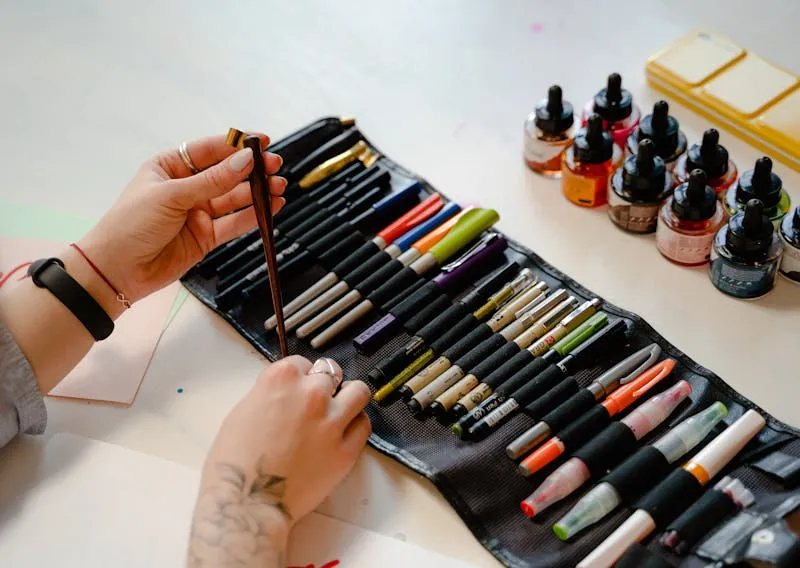
Japanese brush pens are one of those tools that feel like cheating. Whether you’re practicing traditional shodo (calligraphy), working on modern hand lettering, sketching manga, or simply want to add expressive line variation to your writing, a quality brush pen can transform your work overnight. Japan’s stationery companies have been refining brush pen technology for decades — some pens originally designed for writing nengajo (New Year’s greeting cards) and addressing envelopes in formal brush script — and the engineering shows in every stroke.
We’ve tested dozens of Japanese brush pens across multiple disciplines: calligraphy practice, hand lettering, illustration, journaling, and everyday writing. After months of comparative testing on different paper types, at different speeds, and across varying skill levels, we’ve narrowed the field to seven outstanding picks. Whether you’re a complete beginner exploring brush lettering for the first time or an experienced calligrapher looking for the perfect daily tool, there’s a pen here for you.
The beauty of Japanese brush pens is the range. Some use real brush tips made from bundled synthetic fibers that behave like miniature traditional brushes. Others use firm felt tips that offer more control for beginners. Some are refillable with ink cartridges, while others are designed as affordable disposables you replace when they wear out. Understanding these differences is the key to finding the right brush pen for your needs.
Pentel Pocket Brush Pen (GFKP)
The finest brush pen ever made. Its real fiber brush tip delivers extraordinary line variation, the waterproof pigment ink photographs beautifully, and refillable cartridges make it a tool you buy once and use for years.
Check Price on Amazon → Free US shipping on eligible orders *Price approximate at time of writing. Check retailer for current price.Our Top Picks:
- Best Overall: Pentel Pocket Brush Pen (GFKP)
- Best for Color Lettering: Kuretake ZIG Clean Color Real Brush
- Best for Beginners (Hard Tip): Tombow Fudenosuke Hard Tip
- Best for Intermediate (Soft Tip): Tombow Fudenosuke Soft Tip
- Best Budget Pick: Pentel Sign Pen Touch
- Best Dual-Tip: Pilot Futayaku Double-Sided Brush Pen
- Best for Japanese Calligraphy: Kuretake Bimoji Fude Pen
Understanding Brush Pen Types
Before we get into the individual reviews, it helps to understand the two main categories of brush pen tips, because this distinction matters enormously for how the pen feels and what it can do.
Real Brush Tips (Fiber/Hair Tips)
These tips are made from bundled synthetic fibers — sometimes hundreds of individual hairs — that behave like a traditional calligraphy brush. They’re flexible, responsive, and capable of dramatic line variation from hairline thin to bold thick with a single stroke. The Pentel Pocket Brush Pen and Kuretake ZIG Clean Color Real Brush fall into this category.
Real brush tips reward good technique and punish bad habits. They require more control, a lighter touch, and deliberate stroke direction. If you’re coming from traditional calligraphy or watercolor painting, real brush tips will feel natural. If you’re a complete beginner, they can feel unwieldy at first — but the expressive potential is unmatched.
Felt/Elastomer Tips
These tips are made from firm, shaped felt or synthetic elastomer material. They flex under pressure to create line variation, but the range is narrower and more controlled than real brush tips. The Tombow Fudenosuke and Pentel Sign Pen Touch use this type of tip. Felt tips are more forgiving, more predictable, and easier for beginners to control.
The trade-off is expressiveness. Felt tips can’t achieve the extreme thin-to-thick variation of a real brush tip. But for modern hand lettering, bullet journal headers, and controlled decorative writing, felt tips are often the better choice because consistency is more important than dramatic flair.
1. Pentel Pocket Brush Pen (GFKP) — Best Overall
Approx. ~$13 | Rating: 4.8/5 | Best For: Serious calligraphy, illustration, and expressive lettering
The Pentel Pocket Brush Pen is, in our experience, the single finest brush pen ever made. That’s a bold claim, and we stand by it after extensive testing. This pen has been a staple of Japanese illustrators, manga artists, and calligraphers for years, and once you use it, you understand why it has earned such a devoted following.
The tip is a genuine brush — hundreds of synthetic fibers bundled into a precise point that responds to every nuance of pressure and angle. The range of line variation is extraordinary. A whisper-light touch produces hairline strokes thinner than most fine-tip pens can achieve. Moderate pressure gives you clean, even mid-weight lines perfect for body text or careful lettering. Full pressure creates bold, dramatic strokes that would require a large traditional brush to replicate. The transition between these weights is seamless and immediate — the brush responds in real time to your hand, not with a delay.
The ink is a deep, rich black — not gray, not blue-black, but a genuine sumi-like black that photographs and scans beautifully. It’s pigment-based, meaning it’s waterproof once dry. This is a critical feature for illustrators and mixed-media artists: you can ink with the Pentel Pocket Brush and then apply watercolor washes over the top without the lines bleeding or dissolving. For manga artists and comic inkers, this is a non-negotiable requirement, and the Pocket Brush delivers.
The “pocket” form factor is another stroke of genius. The pen is compact enough to carry in a shirt pocket or pencil case, with a sturdy cap that clicks securely into place. Despite its portability, it feels substantial in the hand — well-balanced and comfortable for extended sessions. We’ve used ours for two-hour calligraphy practice sessions without fatigue, which is a testament to the ergonomic design.
Key Features
- Real brush tip with hundreds of synthetic fibers
- Extraordinary line variation from hairline to bold
- Deep, rich, waterproof pigment-based black ink
- Compact, portable design with secure cap
- Refillable with Pentel FP10 ink cartridges (4-pack available)
- Durable tip that maintains its point for thousands of strokes
- Well-balanced body comfortable for extended use
Why It’s Our Top Pick
The Pentel Pocket Brush Pen earns the top spot because it does everything a brush pen should do, and does it at an elite level. The brush tip is the most responsive and versatile we’ve tested. The ink quality is superb. The build quality is excellent. And the refillable cartridge system means this is a pen you buy once and use for years — potentially decades.
The learning curve is real — beginners will need practice to control the sensitive tip — but that’s exactly what makes it rewarding. As your technique improves, the pen grows with you. It never becomes the limiting factor. Many calligraphers we know here in Japan have used the same Pentel Pocket Brush for five or more years, just replacing cartridges as they go. At ~$13 for the pen and roughly ~$6 for a 4-pack of cartridge refills, the long-term cost per use is remarkably low.
If you only buy one brush pen, make it this one.
2. Kuretake ZIG Clean Color Real Brush — Best for Color Lettering
Approx. ~$30 (12-set) | Rating: 4.6/5 | Best For: Colorful hand lettering, journaling, and blending
If the Pentel Pocket Brush is the master calligrapher’s tool, the Kuretake ZIG Clean Color Real Brush is the creative letterer’s dream palette. Available in an astonishing 90 colors — yes, ninety individual shades — this pen puts a real brush tip into every color imaginable, from delicate pastels to rich jewel tones and everything in between.
Kuretake (Kure-take) has been making calligraphy tools in Nara, Japan, since 1902. That’s over 120 years of expertise in brush-making, and the heritage is evident in the ZIG Clean Color Real Brush’s tip design. Each pen features a flexible brush tip made from bundled nylon fibers that produces beautiful line variation. The tip isn’t quite as fine or responsive at its thinnest point as the Pentel Pocket Brush, but it’s impressively versatile for a colored brush pen. You can achieve meaningful thin-to-thick variation that brings hand lettering to life with dimension and character.
The ink is water-based and dye-based, which means two important things for your creative work. First, the colors are intensely vivid — the pigment load is high, and the colors pop on white paper with a vibrancy that rivals professional-grade art markers at a fraction of the price. Second, the water-based formula means you can blend colors together. Lay down one color, then immediately brush over it with another, and they merge on the paper into a smooth gradient. You can also use a water brush to pull color from the tip or to blend dried ink on the page, opening up watercolor-like effects.
We use the ZIG Clean Color Real Brush pens extensively for journal headers, decorative lettering, and illustration accents. The 12-color starter set covers the essentials beautifully with a well-curated selection. And if you get hooked — which is entirely likely — Kuretake sells individual replacement pens in every one of the 90 colors, so you can build your collection strategically.
Key Features
- Real nylon fiber brush tip for genuine line variation
- 90 colors available (sold in 12, 24, 36, 48, 60, and 80+ sets)
- Water-based, blendable dye ink
- Vivid, highly saturated colors
- Odorless, non-toxic, and acid-free
- Individual pen replacement available for every color
Color Lettering Mastery
The ZIG Clean Color Real Brush truly shines when you combine multiple colors in a single lettering piece. Try loading two colors onto the brush tip simultaneously for a gradient effect within each stroke — simply color the tip of one pen with a second color, then letter immediately before the applied color dries. Or letter a word in one color, then immediately trace along one edge with a complementary color while the first is still wet. The colors will merge into a beautiful blend at the boundary that gives your lettering a professional, polished look.
These blending techniques are only possible with a real brush tip and water-based ink, which is why the ZIG Real Brush is our top pick for creative lettering work. Felt-tip brush pens simply cannot replicate these effects.
They pair beautifully with the Tomoe River paper in a Hobonichi Techo for vivid, colorful journal entries, and they work wonderfully alongside the Sakura Pigma Micron for outlined lettering with colorful fills.
Check Price on Amazon (12-Set)
3. Tombow Fudenosuke Hard Tip — Best for Beginners
Approx. ~$4 | Rating: 4.7/5 | Best For: Learning brush lettering, consistent strokes, and controlled line variation
If you’re new to brush lettering, start here. The Tombow Fudenosuke Hard Tip is the single best brush pen for beginners, and it’s not even close. The firm elastomer tip provides just enough flexibility to create beautiful line variation without being so loose that it flails under an inexperienced hand. We think of it as the ideal training partner — challenging enough to teach proper technique, but forgiving enough to produce satisfying results from your very first session.
The hard tip flexes predictably under pressure. Light strokes produce thin upstrokes at approximately 0.3mm width. Firm pressure creates thicker downstrokes up to about 1.5mm. The variation range is narrower than a real brush tip, which is precisely why it works so well for beginners. You get the brush lettering effect — the characteristic thick-thin contrast that makes brush lettering beautiful — without needing to master the extreme control that a real brush tip demands.
The ink is a clean, solid black with good opacity and saturation. It’s water-based and dye-based, so it’s not waterproof once dry. For brush lettering practice, journaling, addressing envelopes, and creating decorative text, the ink quality is more than sufficient. It dries quickly — approximately 2 to 3 seconds on most smooth papers — and doesn’t bleed through quality notebook paper. We’ve used it extensively on Rhodia, Kokuyo Campus, and Maruman paper with excellent results.
The pen body is slim and lightweight, similar in size to a standard felt-tip pen. It’s comfortable to hold for extended practice sessions without causing hand fatigue, and the small form factor means it fits easily into any pencil case or pen roll. At around ~$4 per pen, it’s affordable enough to buy several without guilt — one for your desk, one for your bag, one as a backup.
Key Features
- Firm elastomer tip with controlled, predictable flexibility
- Line variation from approximately 0.3mm to 1.5mm
- Clean black water-based dye ink
- Quick-drying with minimal bleed-through on quality paper
- Slim, lightweight body for comfortable extended use
- Affordable price point ideal for practice
The Perfect Learning Tool
We recommend the Fudenosuke Hard Tip as the first brush pen for anyone learning hand lettering. Start by practicing basic strokes — thin upstrokes (light pressure, pulling toward you) and thick downstrokes (firm pressure, pushing away). Focus on making each stroke consistent and controlled. Once you can reliably make thin and thick strokes, move on to individual letters, then words, then full phrases.
After a few weeks with the Hard Tip, try the Soft Tip version (see our next pick) for more expressive variation and wider line contrast. Then, when you’re ready for maximum expressiveness, graduate to the Pentel Pocket Brush Pen. This progression — Hard Tip to Soft Tip to real brush — is the learning path we recommend to everyone who asks us about getting into brush calligraphy. It works because each step increases the challenge incrementally rather than throwing you into the deep end.
4. Tombow Fudenosuke Soft Tip — Best for Intermediate Users
Approx. ~$4 | Rating: 4.6/5 | Best For: More expressive lettering with greater line variation than the Hard Tip
The Tombow Fudenosuke Soft Tip is the natural next step after mastering the Hard Tip. The tip material is the same elastomer compound, but the formulation is softer and more flexible. It bends more easily under pressure, producing a wider range of thin-to-thick line variation — approximately 0.3mm at the lightest touch up to about 3mm at full pressure. The result is more dramatic, more expressive brush lettering that’s closer to what you’d achieve with a real brush tip, while still maintaining the control and predictability of a shaped elastomer tip.
The increased flexibility means more potential for both beauty and mistakes. Your upstrokes will be thinner, your downstrokes will be thicker, and the contrast between them will be more pronounced and eye-catching. When you nail a word with the Soft Tip, it looks genuinely stunning — the thick-thin transitions have real visual drama. When your pressure control falters, the inconsistency is also more visible. This is exactly the kind of productive challenge that helps you improve as a letterer.
In our testing, we found the Soft Tip particularly excellent for larger lettering — words written at about 1.5 to 2 centimeters (0.6 to 0.8 inches) tall. At this size, the line variation is dramatic and beautiful, and the wider strokes have room to show off the thick-thin contrast. For smaller writing under 1 centimeter, the Hard Tip is more practical because the Soft Tip’s extra flexibility can make small letters feel mushy and difficult to control.
The ink and body are identical to the Hard Tip — same solid black ink formula, same slim lightweight body, same affordable price point. Both pens are often sold together in a twin pack, which is the best way to buy them if you want to compare the two and develop your skills with both.
Key Features
- Soft elastomer tip with greater flexibility than the Hard Tip
- Wider range of thin-to-thick line variation (approximately 0.3mm to 3mm)
- Same clean black ink as the Hard Tip
- Same slim, lightweight body
- Ideal for medium-to-large lettering
- Often sold in a twin pack with the Hard Tip for around $7.50
Hard Tip vs. Soft Tip: Which Should You Choose?
| Feature | Fudenosuke Hard Tip | Fudenosuke Soft Tip |
|---|---|---|
| Tip flexibility | Less flexible | More flexible |
| Line variation range | 0.3mm to 1.5mm | 0.3mm to 3mm |
| Control level | Easier to control | More challenging |
| Best letter size | Small to medium | Medium to large |
| Skill level | Beginner | Intermediate |
| Best for | Practice, small lettering, precision | Expressive lettering, headers, display |
Our honest recommendation: buy both. The twin pack costs about $7.50 — less than two fancy coffees — and having both pens lets you choose the right tool for each project. Use the Hard Tip for practice sessions, small text, and controlled detail work. Use the Soft Tip when you want more drama, more expressiveness, and more visual impact. Over time, you’ll develop a natural sense for which tip suits each task. For a detailed head-to-head breakdown of the Fudenosuke against another popular felt-tip option, see our Tombow Fudenosuke vs Pentel Fude Touch comparison.
Check Price on Amazon (Twin Pack)
5. Pentel Sign Pen Touch — Best Budget Pick
Approx. ~$8 (6-pack) | Rating: 4.5/5 | Best For: Affordable brush lettering with consistent, predictable line variation
The Pentel Sign Pen Touch occupies a unique and valuable space in the brush pen market. Its tip is firmer than a dedicated brush pen but more flexible than a standard felt-tip marker, creating a hybrid that produces brush-like line variation without requiring established brush pen technique. It’s a remarkably accessible pen that bridges the gap between regular writing and brush lettering, making it the easiest possible entry point into the world of expressive line work.
The tip is a flexible felt point that responds to pressure changes smoothly and predictably. Press lightly for thin lines, press firmly for thick lines. The range isn’t as dramatic as the Tombow Fudenosuke — the variation is more subtle — but it’s enough to create attractive brush lettering effects that look polished and intentional. And the consistency of the felt tip means your strokes are predictable and repeatable, which is enormously helpful when you’re trying to letter evenly across a full word or phrase.
What sets the Pentel Sign Pen Touch apart is its dual identity as both a brush pen and an everyday writing tool. It’s not just a specialty calligraphy instrument — it’s a genuinely good pen for everyday tasks. The felt tip writes smoothly in any direction, the ink is clean and dark with excellent opacity, and the pen is comfortable to hold for extended periods. We keep one in our desk pen cup for signing greeting cards, addressing envelopes, and adding handwritten notes to printed documents. It does all of these things well.
The color range is appealing. The pen comes in 12 colors, including a set of muted, sophisticated tones that work beautifully for journaling and decorative writing. The colors are less intense than the Kuretake ZIG but have an understated elegance that we really appreciate — think dusty rose, sage green, and warm gray rather than screaming neon.
Key Features
- Flexible felt tip with brush-like line variation
- 12 colors available including sophisticated muted tones
- Smooth, consistent writing experience in any direction
- Durable tip that doesn’t fray easily under normal use
- Comfortable, familiar pen body
- Excellent value at approximately $1.30 per pen in the six-pack
The Gateway Brush Pen
We call the Pentel Sign Pen Touch the “gateway brush pen” because it’s often the pen that hooks people on brush lettering. It looks like a regular pen, feels like a regular pen, but produces brush-like results that surprise and delight even first-time users. If you’ve been curious about brush lettering but intimidated by dedicated brush pens with their floppy tips and steep learning curves, the Sign Pen Touch is the gentlest possible introduction. And at roughly $1.30 per pen in the six-pack, there’s virtually no financial risk in trying it.
It’s also an excellent pen for bullet journaling headers when you want a touch of brush lettering flair without committing to full calligraphy tools.
Check Price on Amazon (6-Pack)
6. Pilot Futayaku Double-Sided Brush Pen — Best Dual-Tip
Approx. ~$5 | Rating: 4.4/5 | Best For: Versatile lettering with two tip sizes in one pen
The Pilot Futayaku — the name literally translates to “double role” in Japanese, which perfectly describes this pen’s design philosophy — gives you two brush tips in a single pen body. A fine tip on one end and a bold tip on the other. It’s a practical, space-saving design that’s especially useful for lettering projects where you need both a thick brush for main text and a thin pen for details, flourishes, small accents, and address lines.
The bold end features a flexible brush tip that produces expressive line variation with satisfying thick-thin contrast. It’s responsive to pressure changes and creates the kind of dramatic thick downstrokes and thin upstrokes that make brush lettering visually compelling. The brush tip isn’t quite as refined as the Pentel Pocket Brush — it has a slightly more felt-like character and a narrower range of variation — but it’s capable, pleasant to use, and produces attractive lettering results. For most casual and intermediate calligraphers, the difference won’t be a limitation.
The fine end is a firm, thin felt tip that writes more like a precise fine-tip marker than a brush pen. It doesn’t produce significant line variation on its own, but that’s the point. It’s designed for small text, outlines, decorative details, flourishes, and any work where precision matters more than expressiveness. Think of it as the detail brush to the bold end’s broad brush.
The ink is a solid, true black in both tips. Pilot’s ink formulation is reliable and consistent — the black is genuinely dark and opaque, not grayish or washed out the way some brush pen inks can appear. Both tips write smoothly and deliver even ink flow without globbing, skipping, or the dreaded ink flood that can ruin a carefully lettered piece.
We find the Futayaku particularly useful for envelope addressing — a task that comes up surprisingly often in Japanese daily life. Use the bold brush tip for the recipient’s name in elegant, formal calligraphy, then flip the pen and use the fine tip for the street address, city, and postal code in clean, legible text. Two pens’ worth of functionality in one compact tool that fits in your pocket.
Key Features
- Two tips in one pen: fine and bold brush
- Flexible bold tip for expressive calligraphy strokes
- Firm fine tip for details, small text, and precision work
- Rich, true black Pilot ink on both ends
- Compact, space-saving dual-ended design
- Good balance and comfortable grip section
- Affordable price for a dual-function tool
Dual-Tip Strategy for Lettering
The two-tip design isn’t just about convenience — it enables a specific lettering technique we love and use constantly. Write a word or phrase with the bold brush tip in expressive, sweeping strokes. Then, while the layout is fresh in your mind, flip the pen and use the fine tip to add shadows, outlines, decorative flourishes, or companion text. The visual contrast between bold brush strokes and fine details creates sophisticated lettering compositions that would otherwise require switching between multiple pens, breaking your creative flow.
The Futayaku also pairs beautifully with the Kuretake ZIG Clean Color Real Brush — use the ZIG for colorful accents and the Futayaku for black structural lettering and outlines.
7. Kuretake Bimoji Fude Pen — Best for Japanese Calligraphy
Approx. ~$5 | Rating: 4.5/5 | Best For: Japanese calligraphy practice, formal writing, and traditional brush stroke feel
The Kuretake Bimoji — the name means “beautiful characters” (bi = beautiful, moji = characters) — is designed specifically for one purpose: making your handwritten characters beautiful. While the other pens on this list excel at Western-style hand lettering, the Bimoji is engineered for Japanese brush writing — kanji, hiragana, katakana — and for the specific stroke techniques that Japanese calligraphy demands.
The felt brush tip is specially shaped to replicate the behavior of a traditional fude (brush). It tapers to a fine point for starting strokes cleanly, spreads under pressure for bold main strokes, and lifts cleanly for the characteristic harai (sweeping finish) and tome (stopping point) techniques that define Japanese calligraphy. For anyone practicing shodo or simply wanting to write Japanese characters with beauty, authority, and proper stroke character, the Bimoji delivers an experience that’s remarkably close to a traditional brush in a modern, convenient pen format.
The ink is a rich, deep black that evokes traditional sumi (Japanese calligraphy ink). It’s not actual sumi ink — it’s a modern pigment formulation optimized for consistency and longevity — but the visual result on paper is close enough that casual observers wouldn’t notice the difference. The ink flows smoothly and consistently from first stroke to last, and it dries with a matte finish that looks authentic and beautiful on most papers.
Living in Japan, we see the Bimoji absolutely everywhere — in stationery shops of course, but also in convenience stores, at office supply counters, and sitting on the desks of office workers across the country. It’s the pen people reach for when they need to write a condolence card, address a formal envelope, fill out a guest book, or sign a wedding register. That everyday ubiquity speaks volumes about its quality, reliability, and the trust Japanese consumers place in it for their most important handwritten moments.
Key Features
- Specially shaped felt tip designed for Japanese calligraphy strokes
- Rich, sumi-like black ink with matte finish
- Smooth, consistent ink flow from start to finish
- Engineered for kanji, hiragana, and katakana writing
- Available in multiple tip sizes: extra fine, fine, medium, and bold
- Affordable and available at most Japanese stationery retailers
Traditional Meets Modern
The Bimoji bridges the gap between traditional Japanese calligraphy and modern convenience in a way that we find deeply satisfying. Traditional shodo requires a brush, an ink stone (suzuri), an ink stick (sumi), and proper calligraphy paper — a beautiful but time-consuming setup that requires a dedicated workspace. The Bimoji puts a brush-like writing experience in a convenient pen format that you can pull out of your pocket and use anywhere: at your desk, on the train, in a coffee shop, at a friend’s kitchen table.
We recommend the medium tip for general-purpose Japanese calligraphy practice and everyday formal writing. The bold tip is excellent for decorative writing, New Year’s cards, and larger art pieces. The extra fine tip works well for addressing postcards and writing in tight spaces. If you’re learning Japanese and want your handwriting to look more authentic — with proper stroke character rather than the flat, lifeless quality of a ballpoint pen — the Bimoji is the most practical tool available. It pairs beautifully with Kokuyo Campus notebooks for regular practice sessions.
How We Tested
We evaluated every brush pen across six categories to ensure comprehensive, fair comparisons. Our testing team includes experienced calligraphers, hand lettering enthusiasts, and complete beginners to capture performance across skill levels.
Tip Quality and Responsiveness
We tested each pen’s tip for flexibility, snap-back speed (how quickly the tip returns to its original shape after a stroke), point retention (does the tip maintain a fine point over extended use?), and line variation range (the difference between the thinnest and thickest possible strokes). We performed identical stroke drills with each pen to create direct comparisons.
Ink Quality
We assessed ink opacity, color depth, dry time, and consistency of flow. We tested on four paper types: standard copy paper (80gsm), Rhodia dotpad (80gsm), Tomoe River (52gsm), and dedicated calligraphy practice paper. We noted whether each ink bled, feathered, ghosted, or showed through on each paper type.
Control and Forgiveness
We tested each pen at different skill levels. Our testing team includes experienced calligraphers and complete beginners, so we could evaluate how approachable each pen is for newcomers while still assessing its ceiling for advanced users. A pen that’s easy for beginners but limiting for experts scored differently than one that’s challenging for beginners but limitless for experts.
Durability
We used each pen for a minimum of 40 hours of writing and practice to assess tip wear, ink longevity, and mechanical reliability. Pens with replaceable tips or refillable ink cartridges earned consideration for long-term value.
Versatility
We tested each pen for calligraphy, hand lettering, illustration, everyday writing, and journaling. Pens that excelled in multiple categories scored higher than one-trick specialists with narrow use cases.
Value
We calculated cost per pen, availability and cost of refills, color options, and overall quality relative to price. An exceptional pen at a premium price can still be excellent value. A mediocre pen at a budget price is not.
Best Brush Pen by Use Case
For Western-Style Hand Lettering
Pick: Tombow Fudenosuke (start with Hard Tip, then Soft Tip). The controlled elastomer tip produces consistent, beautiful brush lettering without the steep learning curve of a real brush tip. Affordable enough to buy both versions in the twin pack.
For Japanese Calligraphy
Pick: Kuretake Bimoji Fude Pen. Specifically designed for kanji and kana with a tip shaped for traditional stroke techniques including harai, tome, and hane (hook). The closest you’ll get to a traditional fude brush in modern pen form.
For Illustration and Inking
Pick: Pentel Pocket Brush Pen. The waterproof pigment-based ink, extraordinary line variation, and incredibly durable brush tip make it the professional illustrator’s choice. Many manga artists use this pen as their primary inking tool, and it’s been an industry standard in Japan for years.
For Colorful Journaling and Creative Lettering
Pick: Kuretake ZIG Clean Color Real Brush. Ninety colors, real brush tips, and blendable water-based ink create limitless creative possibilities. Essential for anyone who combines lettering with color work.
For Trying Brush Pens for the First Time
Pick: Pentel Sign Pen Touch. The gentlest, most approachable introduction to brush-style line variation. Feels like a regular pen, produces brush-like results, and costs almost nothing in the six-pack.
For Envelope Addressing and Formal Writing
Pick: Pilot Futayaku. The dual-tip design lets you write names in bold brush calligraphy and addresses in fine, legible text — both with a single pen. Practical and elegant.
Brush Pen Care Tips
Protecting Your Tips
- Always recap brush pens immediately after use — brush tips dry out faster than ballpoint or gel pen tips, and a dried-out tip is a ruined tip
- Store brush pens horizontally or tip-down (check manufacturer recommendations for your specific pen) to keep ink flowing to the tip
- Never press a brush tip straight down at a 90-degree angle — this splays the fibers outward and can permanently damage the point geometry
- Clean real brush tips periodically by stroking them gently on a damp paper towel to remove dried ink buildup between the fibers
Paper Matters
Brush pens perform their best on smooth paper. Rough, toothy paper catches and frays brush tip fibers over time, dramatically shortening tip life. We recommend Rhodia pads, Kokuyo Campus notebooks, Tomoe River paper, or HP Premium 32lb paper for brush lettering practice. Standard copy paper works in a pinch but will wear brush tips faster than smooth paper — treat copy paper as a practice surface, not your main paper.
Practice Fundamentals
Don’t jump straight into lettering words. Spend your first sessions practicing basic strokes: thin upstrokes, thick downstrokes, curves, transitions between weights, and lifted strokes. The Tombow Fudenosuke Hard Tip is ideal for these fundamental exercises because its controlled tip lets you focus on pressure technique without fighting an overly flexible brush. Once your basic strokes are consistent, individual letters will come together naturally. For sketching guidelines before inking, pair your brush pen with a reliable Japanese mechanical pencil to lay down light, erasable outlines first.
Brush Pen Comparison Table
| Pen | Price | Tip Type | Colors | Refillable | Best For |
|---|---|---|---|---|---|
| Pentel Pocket Brush | ~$13 | Real brush (fiber) | Black | Yes (cartridges) | Calligraphy, inking |
| Kuretake ZIG Real Brush | ~$30/12-set | Real brush (nylon) | 90 | No | Color lettering |
| Tombow Fudenosuke Hard | ~$4 | Elastomer | Black, colors | No | Beginners |
| Tombow Fudenosuke Soft | ~$4 | Elastomer | Black, colors | No | Intermediate |
| Pentel Sign Pen Touch | ~$8/6-pack | Felt | 12 | No | Budget, everyday |
| Pilot Futayaku | ~$5 | Felt brush (dual) | Black | No | Dual-tip versatility |
| Kuretake Bimoji | ~$5 | Felt brush | Black | No | Japanese calligraphy |
Frequently Asked Questions
What’s the best brush pen for absolute beginners?
The Tombow Fudenosuke Hard Tip is our top recommendation for beginners who want a “real” brush pen experience. Its firm elastomer tip provides controlled, predictable line variation that’s easy to learn with. The Pentel Sign Pen Touch is an even gentler introduction if the Fudenosuke feels too unfamiliar — it writes more like a regular felt-tip pen with subtle brush-like line variation. Start with either of these, practice basic strokes for a few weeks, and then explore more flexible options as your control develops.
Can I use brush pens on regular copy paper?
Yes, but with caveats. Brush pens function on regular copy paper, but the paper’s rough texture wears down brush tips significantly faster than smooth paper. You’ll also see more feathering (fuzzy line edges) and potential bleed-through on thin copy paper, especially with heavily loaded tips. For practice and casual use, regular paper is fine — just accept the faster tip wear as a cost of convenience. For finished work and to extend tip life as long as possible, use smooth paper like Rhodia, Clairefontaine, or HP Premium 32lb.
How long do brush pen tips last?
It depends heavily on the pen, the paper, and your pressure habits. The Pentel Pocket Brush Pen’s real fiber tip can last for months or even years of regular use because the high-quality synthetic fibers are extremely durable and the tip is designed for professional-grade longevity. Felt and elastomer tips like the Tombow Fudenosuke will gradually wear down and lose their point after heavy use, typically lasting 2 to 3 months of daily practice. Using smooth paper and maintaining light to moderate pressure significantly extends tip life for all brush pens.
Are Japanese brush pens good for modern calligraphy?
Absolutely. Modern calligraphy — sometimes called “faux calligraphy” or “brush lettering” — was practically built on Japanese brush pens. The Tombow Fudenosuke is the most popular brush pen in the global hand lettering community, recommended by the vast majority of lettering instructors and tutorial creators. The Pentel Pocket Brush is the tool of choice for professional calligraphers who need maximum expressiveness. Japanese brush pens offer the best combination of tip quality, ink quality, and value in the market, bar none.
What’s the difference between a brush pen and a calligraphy pen?
A brush pen has a flexible tip — either real fibers or shaped felt/elastomer — that creates line variation through pressure changes. Press harder for thick strokes, lighter for thin. A traditional calligraphy pen has a rigid metal nib (usually flat or pointed) that creates line variation through the angle of the nib or flex in the tines. Both produce beautiful lettering, but the techniques are different. Brush pens are generally more accessible for beginners because the pressure-based technique is intuitive. For fountain pen and dip pen calligraphy options, see our best Japanese fountain pens guide.
Can brush pen ink be erased?
No, standard brush pen ink — whether pigment-based or dye-based — is not erasable once on the paper. This is different from erasable pens like the Pilot FriXion, which use special thermochromic ink. For brush lettering practice, embrace mistakes as part of the learning process. Many experienced calligraphers keep all their practice sheets, including the messy early ones, as motivation to see how far they’ve come.
Which brush pen is best for Tombow lettering worksheets?
The Tombow Fudenosuke Hard Tip or Soft Tip are the natural choices since Tombow designs their worksheets specifically for these pens. However, any brush pen on this list will work with lettering practice worksheets from any brand. The key is matching the pen’s tip size to the worksheet’s letter size — larger practice letters work better with more flexible, broader tips like the Soft Tip or the Kuretake ZIG, while smaller practice guides suit the controlled Hard Tip.
Final Verdict
Japanese brush pens represent decades of engineering refinement rooted in centuries of calligraphic tradition, and the seven pens in this guide are the best we’ve tested across all skill levels and use cases. Each serves a different purpose and excels in a different context, so the “best” brush pen depends entirely on your needs and experience level.
For the absolute best brush pen experience money can buy, the Pentel Pocket Brush Pen is unmatched. Its real brush tip, waterproof pigment-based ink, and refillable cartridge design make it a tool that will serve you for years — or even decades — of creative work. For beginners just starting their brush lettering journey, the Tombow Fudenosuke Hard Tip is the ideal starting point: affordable, forgiving, and genuinely capable of producing beautiful results from day one. For color work and creative lettering, the Kuretake ZIG Clean Color Real Brush opens up a world of possibilities with its 90-color range and blendable water-based ink.
Whatever your skill level, brush lettering and calligraphy are deeply rewarding practices. The meditative focus of forming each stroke, the satisfaction of watching your lettering improve over time, the creative joy of expressing words as visual art — these are experiences that a quality Japanese brush pen makes not just possible, but genuinely pleasurable.
Check Tombow Dual Brush 10-Pack Set on Amazon | Check Pentel Pocket Brush Price on Amazon | Check Tombow Fudenosuke Twin Pack on Amazon | Check Kuretake ZIG Price on Amazon
For more pen recommendations, see our Best Japanese Gel Pens and Complete Beginner’s Guide to Japanese Stationery.