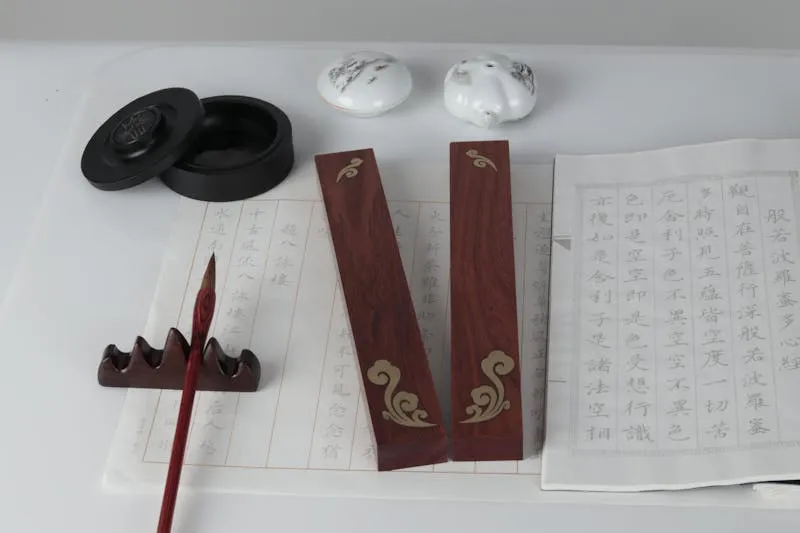
Japanese calligraphy — shodou (書道, “the way of writing”) — is one of the most beautiful and accessible art forms in Japan. Every Japanese student learns calligraphy in school, starting with basic strokes and progressing to complex kanji (漢字, Chinese characters) over years of practice. The brushwork is meditative, the results are striking, and the skills transfer directly to modern hand lettering and brush pen calligraphy.
The good news for beginners: you don’t need a traditional brush, ink stone, and rice paper to get started. Japanese stationery companies have created brush pens that capture the essential feel of calligraphy brushwork in a convenient, modern pen format. These Japanese calligraphy pens are affordable, portable, and produce stunning results right out of the package.
We’ve tested dozens of brush pens from Japan’s top manufacturers — Pentel, Kuretake, Tombow, Pilot, and Sakura — to find the best options for beginners who want to explore Japanese calligraphy. Whether your goal is traditional shodou practice, modern brush lettering, or decorative journaling, this guide will help you find the right pen and get started.
Understanding Japanese Calligraphy Pens
Before choosing a pen, it helps to understand the different types available and how they relate to traditional calligraphy tools.
Traditional vs. Modern Calligraphy Tools
Traditional Japanese calligraphy uses a fude (筆, brush) made from animal hair — typically weasel, horse, or goat — dipped in sumi (墨, ink) ground on an suzuri (硯, ink stone). This setup produces the most authentic calligraphic results, but it’s messy, requires preparation time, and has a steep learning curve.
Modern brush pens replicate the essential function of a traditional brush — the ability to create thick and thin strokes by varying pressure — in a self-contained, ink-filled pen. The best Japanese brush pens come remarkably close to the feel of a real brush, making them ideal training tools and excellent creative instruments in their own right.
Brush Pen Tip Types
Japanese calligraphy pens come in three main tip categories:
Felt/Fiber Tip: A firm, shaped felt tip that flexes under pressure. Produces consistent, controllable lines. The easiest type for beginners because the tip provides predictable resistance. Example: Pentel Fude Touch Sign Pen.
Nylon Brush Tip: A bundle of synthetic nylon fibers that mimics a traditional brush. Offers more flexibility and expression than felt tips, with greater thick-thin variation. Moderate difficulty. Example: Tombow Fudenosuke.
Natural Hair Brush Tip: A genuine animal hair brush attached to a pen barrel. The closest to a traditional calligraphy brush. Maximum flexibility and expression, but the most difficult to control. Best for experienced users. Example: Kuretake No. 13.
For beginners, we recommend starting with a felt or nylon brush tip before progressing to natural hair.
Best Japanese Calligraphy Pens for Beginners
Pentel Fude Touch Sign Pen — Best Starting Point
Approx. ~$12 (6-pack) | Tip Type: Felt/fiber | Colors: 12 | Difficulty: Beginner
The Pentel Fude Touch Sign Pen is our top recommendation for absolute beginners. The medium-flex felt tip provides enough variation for beautiful thick-thin strokes while being forgiving enough to produce clean results even with imperfect technique. It’s the training wheels of brush calligraphy — supportive but not limiting.
The ink is water-based and dye-based, producing vibrant, saturated colors. The black is deep and rich, excellent for practicing kanji strokes. The felt tip is durable and holds its shape well — even after weeks of daily practice, the tip maintains its point without fraying.
What makes the Fude Touch ideal for beginners is the feedback it provides. The felt tip gives you a clear sense of how pressure translates to line width, which is the foundational skill of brush calligraphy. Press lightly for thin upstrokes (harai, 払い), press firmly for thick downstrokes (tome, 止め), and you’ll see the results immediately.
Best for: First-time brush pen users, basic stroke practice, modern brush lettering, journaling accents.
Check Price on Amazon (6-Pack)
Kuretake ZIG Clean Color Real Brush — Best for Color Calligraphy
Approx. ~$28 (24-pack) | Tip Type: Nylon brush | Colors: 80 | Difficulty: Beginner to Intermediate
The Kuretake ZIG Clean Color Real Brush pen bridges the gap between calligraphy tools and art supplies. The flexible nylon brush tip behaves like a real brush — bending, spreading, and responding to pressure with remarkable sensitivity. The 80-color range is the largest of any brush pen line, making it ideal for colorful calligraphy, illustration, and creative journaling.
Kuretake (くれ竹) has been manufacturing calligraphy supplies in Nara, Japan since 1902 — over 120 years of brush-making expertise. That heritage shows in the ZIG’s brush tip, which has a natural, responsive feel that’s closer to a real brush than most synthetic alternatives. The tip springs back to its original shape after bending, maintaining consistent performance over the life of the pen.
The water-based ink is blendable — overlap colors while wet and they mix smoothly on the paper. This opens up creative possibilities beyond basic calligraphy: gradients, color transitions, and watercolor-like effects. Use a water brush to spread and blend the ink further.
Best for: Colorful calligraphy work, blending techniques, illustration, creative journaling, intermediate practice.
Check Price on Amazon (24-Pack)
Tombow Fudenosuke Brush Pen — Best for Skill Development
Approx. ~$6 (2-pack, hard + soft) | Tip Type: Nylon/elastomer | Colors: Black, gray, 10 colors | Difficulty: Beginner to Intermediate
The Tombow Fudenosuke is the pen that lettering instructors reach for first. Available in two tip firmness levels — hard and soft — it gives beginners a clear path for skill progression. Start with the hard tip for controlled, precise strokes, then graduate to the soft tip for more expressive, dynamic calligraphy.
The hard tip produces thin-to-medium line variation. It’s responsive enough to create beautiful thick-thin contrast but firm enough to prevent the tip from collapsing under pressure — a common beginner mistake. Lines are clean, controlled, and precise. This is the best tip for learning basic calligraphy strokes and practicing consistent letter forms.
The soft tip offers wider line variation and greater expressiveness. It bends more readily under pressure, producing thick downstrokes that approach the width of a traditional calligraphy brush. It requires more control — press too hard and the line blobs; press too light and the line disappears — but the results are more dynamic and visually striking.
The twin pack (one hard, one soft) is one of the best values in the brush pen world. For ~$6, you get two professional-quality brush pens that will serve you from beginner to intermediate level. For a detailed look at the full Tombow brush pen lineup, see our Tombow Dual Brush Pen review.
Best for: Learning brush lettering fundamentals, skill progression, small-scale calligraphy, addressing envelopes.
Check Price on Amazon (2-Pack)
Pilot Futayaku Double-Sided Brush Pen — Best Dual-Tip
Approx. ~$5 | Tip Type: Felt/fiber (fine + broad) | Colors: Black | Difficulty: Beginner
The Pilot Futayaku is a practical, no-nonsense calligraphy pen with two tips: a fine tip for detail work and a broad tip for expressive strokes. Having both sizes in one pen is convenient for practice — use the broad tip for full-size character practice and the fine tip for smaller writing and detail work.
The ink is a deep, rich black with excellent opacity. It dries quickly on most papers, which prevents smudging during practice. The felt tips are firm and durable, suitable for the repetitive stroke practice that calligraphy demands.
Best for: Practicing characters at two different scales, everyday calligraphy practice, a compact calligraphy toolkit.
Essential Calligraphy Strokes to Practice
Japanese calligraphy is built on fundamental strokes that combine to form every character. Mastering these basic strokes is more important than attempting complex characters early.
The Eight Basic Strokes (Eiji Happou, 永字八法)
The character 永 (ei, “eternity”) contains all eight fundamental strokes of Japanese calligraphy. Traditionally, students practice this single character hundreds of times before moving on. The eight strokes are:
- Soku (側) — The dot. A short, angled press that creates a small mark. Appears in characters like 犬 and 文.
- Roku (勒) — The horizontal stroke. Drawn left to right with even pressure. The backbone of characters like 一, 二, 三.
- Do (努) — The vertical stroke. Drawn top to bottom with controlled pressure. Central to characters like 十 and 中.
- Teki (趯) — The upward flick. A stroke that ends with an upward hook. Found in characters like 子 and 小.
- Saku (策) — The rightward diagonal rising stroke. Drawn from lower-left to upper-right. Appears in 人 and 大.
- Ryaku (掠) — The leftward sweeping stroke. A graceful diagonal from upper-right to lower-left. Key to characters like 木 and 人.
- Taku (啄) — The short leftward stroke. A quick, sharp diagonal. Found in 少 and 千.
- Taku (磔) — The rightward sweeping stroke with a press at the end. The most expressive stroke, seen in 之 and 道.
Practice Method
For each stroke, practice with the following approach:
- Slow, deliberate strokes first. Speed comes later. Focus on controlling the brush tip and producing consistent line width.
- Vary pressure intentionally. Practice pressing firmly for thick sections and lifting for thin sections. This is the core skill of calligraphy.
- Repeat each stroke 20-30 times before moving to the next one. Muscle memory develops through repetition.
- Compare your results to printed examples. Look for consistency in width, angle, and curvature.
Choosing the Right Paper
Paper matters more for calligraphy than for standard writing. The wrong paper can make even the best brush pen feel scratchy, bleed excessively, or dry unevenly.
Best Papers for Brush Pen Calligraphy
Tomoe River (52gsm): The smoothest option. Ink sits on the surface, producing crisp edges and vivid color. Excellent for fine brush work but can cause pooling with very wet pens.
Rhodia Paper (80gsm): Smooth, coated paper that handles brush pens beautifully. Good line definition and minimal bleeding. Available in dotted, gridded, and lined formats.
Kokuyo Campus (75gsm): A solid everyday option. Smooth enough for brush work, with good ink absorption that prevents pooling. Affordable and widely available. See our Kokuyo Campus review for details.
Maruman Mnemosyne: Premium smooth paper with excellent brush pen compatibility. The smoothness allows the brush tip to glide without snagging.
Traditional Calligraphy Paper (hanshi, 半紙): Thin, absorbent paper designed specifically for calligraphy with traditional ink. It absorbs ink differently than modern paper, creating softer edges and natural feathering that are part of the traditional aesthetic. Available cheaply in bulk on Amazon.
Papers to Avoid
Avoid highly textured or rough papers for brush pen calligraphy. The texture catches the brush fibers, causing fraying, uneven ink flow, and inconsistent line quality. Standard printer paper works in a pinch but tends to feather with wet brush pens.
From Calligraphy to Modern Brush Lettering
Once you’re comfortable with basic strokes using Japanese calligraphy pens, the skills transfer directly to modern brush lettering — the art of creating decorative, stylized text with brush pens.
Key Differences
| Aspect | Traditional Calligraphy | Modern Brush Lettering |
|---|---|---|
| Scripts | Kanji, hiragana, katakana | Latin alphabet, numbers, symbols |
| Rules | Strict stroke order and proportions | Flexible, creative expression |
| Goals | Accuracy, beauty, discipline | Style, personality, decoration |
| Tools | Traditional brush or brush pen | Brush pens, markers |
| Paper | Hanshi or smooth paper | Any smooth paper |
The Fundamental Rule (for Both)
Whether you’re writing traditional kanji or modern English lettering, the core principle is the same: thin upstrokes, thick downstrokes. When your brush moves upward or to the right, use light pressure for a thin line. When it moves downward or to the left, use firm pressure for a thick line. This contrast is what makes brush lettering visually dynamic.
Practice this principle with your name. Write each letter slowly, consciously applying light pressure on upstrokes and firm pressure on downstrokes. Once this becomes automatic, your lettering will immediately look more professional.
Frequently Asked Questions
What is the best Japanese calligraphy pen for complete beginners?
The Pentel Fude Touch Sign Pen is our top recommendation for complete beginners. The firm felt tip provides enough resistance to produce controlled strokes without collapsing under pressure. It’s affordable, widely available, and produces beautiful results even with imperfect technique. Start here, then progress to the Tombow Fudenosuke as your skills develop.
Can I learn Japanese calligraphy with brush pens instead of a traditional brush?
Yes. Brush pens are actually the recommended starting point for most modern calligraphy learners. They develop the same fundamental skills — pressure control, stroke consistency, and brush angle management — in a more convenient format. Many calligraphy instructors in Japan now teach with brush pens in introductory classes before transitioning students to traditional tools.
How long does it take to learn basic Japanese calligraphy?
With regular practice (15-30 minutes daily), most people can produce recognizable, attractive basic strokes within 2-4 weeks. Achieving consistency and flow takes 2-3 months. Mastering complex kanji characters with proper proportions and brush dynamics is a lifelong pursuit — which is part of calligraphy’s enduring appeal.
What’s the difference between the Tombow Fudenosuke hard and soft tip?
The hard tip has more resistance, producing thinner lines and more controlled strokes. It’s better for beginners, small lettering, and precise work. The soft tip flexes more, producing wider line variation and more expressive strokes. It’s better for larger lettering, bold calligraphy, and once you’ve developed basic pressure control. The 2-pack includes both, so you can compare directly.
Can I use these brush pens for journaling too?
Absolutely. Japanese calligraphy pens are excellent for adding decorative headers, titles, and accents to journal pages. The Pentel Fude Touch Sign Pen and Kuretake ZIG are particularly popular in the bullet journaling community for creating beautiful headers and custom lettering.
Are Japanese brush pens waterproof?
It depends on the specific pen. Most brush pens use water-based ink that is not waterproof — it will smear if exposed to water after drying. If you need waterproof brush lettering (for envelopes, outdoor signage, or mixed-media art), look for brush pens specifically labeled as waterproof or pigment-based, such as the Pentel Pigment Ink brush pen or the Sakura Pigma Micron (which has a fine tip rather than a brush tip).
Getting Started: Your First Calligraphy Kit
Here’s our recommended starter kit for Japanese calligraphy beginners:
- Pentel Fude Touch Sign Pen (6-pack) — Your primary practice pen — Check Price
- Tombow Fudenosuke (hard + soft 2-pack) — For skill progression — Check Price
- A smooth-paper notebook — Rhodia dotpad or Kokuyo Campus
- Printed stroke guides — Free downloadable practice sheets are widely available online
Total cost: approximately ~$18 for the pens, plus a notebook. That’s everything you need to begin your calligraphy journey.
The beauty of Japanese calligraphy is that it combines artistic expression with meditative practice. Each stroke requires focus and intention, making it a genuinely relaxing creative outlet. Start with basic strokes, practice regularly, and you’ll be surprised how quickly the movements become natural.
For more brush pen options, see our guides to the best Japanese brush pens and the Tombow Dual Brush Pen review. And for a broader introduction to Japanese stationery, check our beginner’s guide.