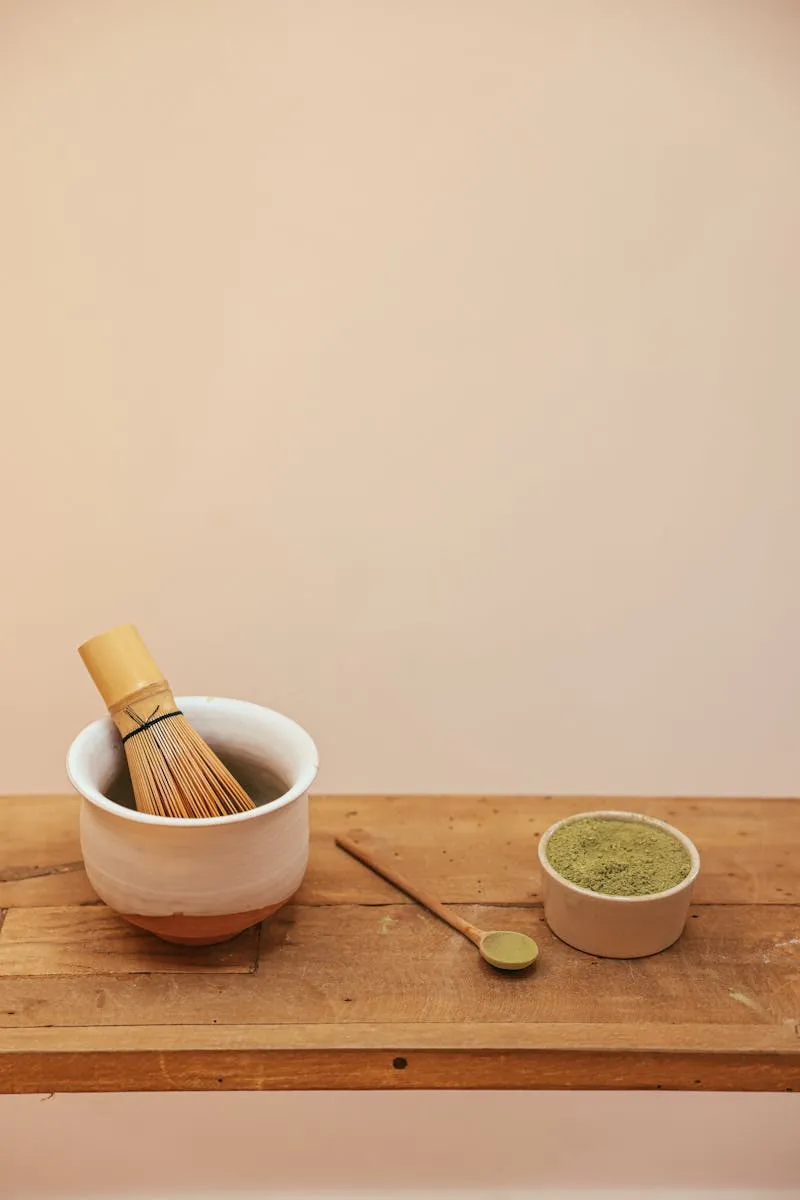
Making matcha at home is a simple ritual that takes two minutes but transforms your morning — or afternoon, or evening. The bright green tea, whisked to a smooth froth in a warm bowl, is both a moment of calm and a genuine health benefit. But making good matcha requires proper tools. A spoon and a mug won’t produce the same result as a bamboo whisk and a ceramic bowl. The tools aren’t expensive, and they last for years.
Living in Japan, we’ve participated in tea ceremonies and made daily matcha at home. Here’s everything you need to make authentic matcha, explained practically.
The Essential Tools
1. Chasen (茶筅) — Bamboo Whisk
Price: ~$10-25 | Material: Single piece of bamboo, hand-carved
The chasen is the most important matcha tool. This bamboo whisk has 80-120 thin tines carved from a single piece of bamboo, designed to break up matcha powder clumps and create a smooth, frothy suspension. No other tool — not a spoon, not a fork, not an electric frother — produces the same result.
The whisking motion is specific: rapid back-and-forth (not circular) wrist movement in a “W” or “M” pattern. This motion incorporates air while distributing the powder evenly. Within 15-20 seconds of proper whisking, the matcha develops a fine, stable foam.
Choosing a chasen:
- 80 tines (八十本立) — Standard for everyday matcha. Produces good froth with moderate effort.
- 100 tines (百本立) — More tines create finer froth with less effort. Our recommendation.
- 120 tines (百二十本立) — Premium option. The finest froth, most forgiving technique.
Material:
- White bamboo (淡竹) — Standard, widely available, affordable
- Purple bamboo (紫竹) — Darker color, slightly different aesthetics
- Smoked bamboo (煤竹) — Aged appearance, premium
We recommend a 100-tine white bamboo chasen for most home users. It’s forgiving enough for beginners and capable enough for experienced tea makers.
2. Chawan (茶碗) — Matcha Bowl
Price: ~$15-40 | Material: Ceramic/pottery
The chawan is a wide, open bowl specifically shaped for matcha preparation. The wide opening provides space for the chasen’s whisking motion — a narrow mug restricts the whisk and prevents proper froth development.
Shape matters:
- Wide and shallow — Easier to whisk, cools tea faster
- Tall and narrow — Harder to whisk, keeps tea warmer
- Standard (wan-nari) — Balanced shape for everyday use
The interior should be relatively smooth for easy cleaning. The exterior can be rough, glazed, or decorated — this is where the aesthetic personality of tea ceremony appears.
Choosing a chawan: For daily home use, a simple, functional chawan in the $15-25 range is perfect. You don’t need a $200 hand-thrown ceremony bowl for morning matcha. Look for a wide opening (approximately 4.5-5 inches / 12-13cm diameter), comfortable hand-feel, and stable base.
3. Chashaku (茶杓) — Bamboo Scoop
Price: ~$5-10 | Material: Bamboo
The chashaku is a slender bamboo scoop used to measure matcha powder. One level scoop equals approximately 1 gram — the standard amount for a bowl of usucha (thin matcha, the everyday preparation). Two scoops for koicha (thick matcha, the ceremony preparation).
You can substitute a measuring spoon (1/2 teaspoon ≈ 1 gram of matcha), but the chashaku is inexpensive and the scooping motion becomes part of the ritual.
4. Furui (篩) — Matcha Sifter
Price: ~$5-8 | Material: Stainless steel mesh
A fine-mesh sifter removes clumps from matcha powder before whisking. Matcha clumps easily due to its fine particle size and static charge. Sifting takes 10 seconds and dramatically improves the smoothness of the finished tea.
You can use any fine-mesh strainer, but dedicated matcha sifters are sized to sit on top of the chawan, making the process clean and efficient.
Complete Matcha Sets
For the easiest start, buy a complete set:
Recommended Set: Basic Matcha Tool Set
Price: ~$25-35 | Includes: Chasen (80-100 tines), chawan, chashaku, and sometimes a chasen holder
A complete set ensures all tools are quality-matched and sized appropriately. Buying individually is fine too — there’s no compatibility concern.
How to Make Matcha
Usucha (薄茶) — Thin Matcha (Everyday)
-
Heat water to 175-180 degrees Fahrenheit (80 degrees Celsius). Boiling water (212 degrees Fahrenheit / 100 degrees Celsius) makes matcha bitter. If you don’t have a temperature-controlled kettle, boil water and let it cool for 2-3 minutes.
-
Warm the chawan by pouring hot water into the bowl, swirling, and discarding. This prevents the bowl from cooling the tea.
-
Sift matcha — Place the sifter on the chawan and sift 1-2 scoops (1-2 grams) of matcha through it.
-
Add water — Pour 2-3 ounces (60-80ml) of hot water into the bowl.
-
Whisk — Using the chasen, whisk vigorously in a “W” motion for 15-20 seconds. Start with the whisk touching the bottom of the bowl to break up powder, then lift slightly to incorporate air. Aim for a fine, uniform foam on the surface.
-
Drink — Hold the chawan with both hands. Enjoy immediately — matcha settles quickly.
Koicha (濃茶) — Thick Matcha (Ceremony)
Use double the matcha (3-4 scoops) with half the water. Knead the mixture with the chasen rather than whisking — slow, circular motions that create a thick, paste-like consistency. Koicha requires higher-quality matcha (ceremony grade) because the concentrated preparation reveals any bitterness.
Caring for Your Tools
Chasen Care
The chasen is the most delicate tool and requires proper care for longevity:
- After each use: Rinse thoroughly under running water while gently reshaping the tines. Do NOT use soap.
- Drying: Place on a chasen holder (kusenaoshi) or stand upright to dry. Never leave in a bowl of water.
- Storage: Store in a dry, ventilated area. The original plastic tube provides protection during storage.
- Lifespan: A quality chasen lasts 6-12 months of daily use. The tines will gradually break and thin. Replace when fewer than half the original tines remain or when froth quality declines.
Chawan Care
- Rinse immediately after use (dried matcha is harder to clean)
- Hand wash with warm water and a soft sponge
- Unglazed pottery may absorb matcha color over time — this is normal and considered part of the bowl’s character
- Avoid sudden temperature changes (don’t pour boiling water into a cold ceramic bowl)
Chashaku Care
- Rinse after use, wipe with a dry cloth
- Store flat — bamboo can warp if stored upright in humid conditions
- The bamboo may darken with use — this is natural and not a defect
Choosing Matcha Powder
The tools are important, but the matcha itself determines the flavor. For daily drinking:
- Ceremony grade (matcha-ten): Vibrant green color, smooth, minimal bitterness. Best for whisked matcha. $25-40 per 30g tin.
- Culinary grade: Stronger, more bitter, less vibrant. Best for matcha lattes and baking. $10-20 per 30g.
Look for matcha from Uji (Kyoto) or Nishio (Aichi) — Japan’s premier matcha regions. Avoid matcha that’s yellowish or brown, which indicates oxidation or low quality.
Beyond Basic Matcha
Matcha Latte
Whisk matcha as usual, then add steamed milk (dairy or non-dairy). The chasen creates a better base for lattes than a spoon — the powder is fully dissolved without clumps.
Iced Matcha
Whisk matcha with a small amount of hot water (just enough to dissolve), then pour over ice. Add cold water or milk to desired strength.
Matcha as Part of Japanese Tea Culture
For more about Japanese tea traditions, see our Japanese tea sets guide, which covers kyusu teapots, yunomi cups, and regional pottery styles. If you’re building a full Japanese kitchen alongside your tea practice, our essential Japanese kitchen tools guide covers everything from mandolines to graters. And for the complete overview, see our complete guide to the Japanese kitchen.
Frequently Asked Questions
Do I really need a bamboo whisk, or can I use an electric frother?
An electric frother works but produces a different result — larger, less stable bubbles compared to the fine, dense microfoam from a chasen. The bamboo whisk also contributes to the ritual aspect of matcha preparation. For daily convenience, an electric frother is acceptable. For the authentic experience, use a chasen.
How long does a chasen last?
With daily use, 6-12 months. With occasional use (a few times per week), 1-2 years. The tines gradually break and thin — this is expected and normal. A new chasen starts with pristine, tightly curled tines; an end-of-life chasen has visibly fewer, straighter tines and produces less froth.
Why does my matcha taste bitter?
Three likely causes: water temperature too high (use 175-180 degrees Fahrenheit, not boiling), low-quality matcha (upgrade to ceremony grade), or too much powder (use 1-2 grams). All three are easily fixed.
Can I make matcha without a chawan?
Yes — any wide-mouth bowl works. The key requirement is enough width for the chasen to move freely (at least 4 inches diameter). A cereal bowl works in a pinch. The chawan is ideal but not strictly necessary.
Is matcha actually healthier than regular green tea?
Yes — because you consume the entire tea leaf (ground into powder), you ingest more antioxidants, L-theanine, and other beneficial compounds than with steeped green tea, where the leaves are discarded. One cup of matcha contains roughly the antioxidants of 10 cups of brewed green tea.